
JST XH vs VH: Choosing a Cable Connection for Your Board and Load
Table of Contents
JST XH and VH are different wire-to-board systems, not two sizes of the same interchangeable plug. XH uses 2.50 mm contact spacing; VH uses 3.96 mm. A decision between them should start with the mating header and the electrical load, then account for the wire, assembled space and retention arrangement.
For an existing board, match its approved header. For a new design, compare the complete connection. VH's higher catalog current values can make it a candidate for a different load class, but they do not turn every VH cable into a 10 A assembly. XH can be a candidate where its smaller interface and selected wire combination meet the requirements.
XH vs VH: the useful specification differences
The following values describe original JST components in the cited catalogs, checked on 29 September 2026. They do not independently rate a finished harness or an unbranded alternative.
| Selection point | JST XH | JST VH |
|---|---|---|
| Contact pitch | 2.50 mm | 3.96 mm |
| Catalog current conditions | 3 A AC/DC with AWG 22 | 10 A with AWG 16 and standard header; 7 A with AWG 18 and shrouded header |
| Catalog voltage | 250 V AC/DC | 250 V AC/DC |
| Catalog temperature | −25 to +85 °C, including current-induced rise | −40 to +105 °C, including current-induced rise |
| Example standard contact | SXH-001T-P0.6: AWG 28–22, insulation OD 0.9–1.9 mm | SVH-21T-P1.1: AWG 22–18, insulation OD 1.7–3.0 mm |
| Another contact option | SXH-002T-P0.6: AWG 30–26, OD 0.9–1.3 mm | SVH-41T-P1.1: AWG 20–16, OD 1.7–3.0 mm |
| Reference top-entry assembled height | 9.8 mm | 16.5 mm |
| Retention and interface | Shrouded header with series-specific mating features | External housing lock; standard and shrouded header variants |
| Example housing reference | XHP-4 | VHR-4N |
References: JST XH catalog, pages 1–4; JST VH catalog, pages 1–3. Heights are reference configurations, not universal enclosure clearances. Verify the full part drawings and ordering suffixes.
Browse XH-series alternative connectors, VH-series alternative connectors. These product pages cover alternatives; select the exact housing, contact and mating interface for your application.
Start with the board-side interface
For a replacement cable, the installed header constrains the choice. Record the exact header, housing, terminal, circuit count and mating direction. If the original bill of materials is unavailable, send photographs of the mating face, side profile and board header, plus measured contact spacing. A label such as “JST power cable” is not sufficient identification.
XH's nominal pitch is 2.50 mm, not 2.54 mm. Do not choose a header from an approximate ruler reading or marketplace label. On a four-position housing, the first-to-last contact-center distance covers three pitches: 7.50 mm for XH and 11.88 mm for VH. This calculation can help screen a sample, but the complete interface still needs confirmation.
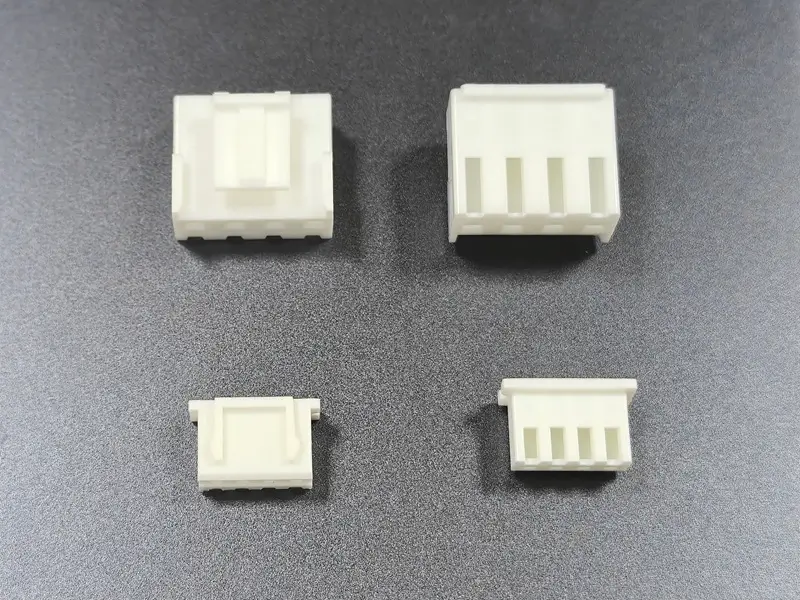
Alternative housings for the XH and VH series. Shown for visual comparison; original JST catalog specifications do not rate these samples.
Neither housing nor terminal can be substituted across these series simply because the circuit count matches. A change from XH to VH normally means a coordinated review of the PCB header, footprint, harness drawing and enclosure. Preserve electrical pin mapping explicitly when changing the mechanical interface.
Read the current rating as a configuration, not a promise
Before selecting either series, define steady current, any startup or transient load, duty cycle, ambient temperature and how the harness is bundled or enclosed. Then check the selected components and cable as an assembly. A connector catalog value does not establish an acceptable temperature rise for an unspecified finished product.
For VH, the standard-header and shrouded-header conditions in the table are distinct. Do not quote the 10 A value for a different header and wire combination. Equally, the XH value does not apply unchanged to every smaller wire that fits an XH contact.
JST also cautions against exceeding a circuit rating by simply dividing a larger load across parallel VH contacts: unequal sharing requires design consideration and margin. Treat any parallel arrangement as an engineering decision, not an automatic multiplication of the catalog rating. VH catalog, page 1
The same nominal voltage in a comparison table does not settle equipment-level insulation or compliance requirements. Review the intended installation and applicable product requirements before releasing the design.
Check the wire, terminal and housing together
Specify conductor construction, AWG and insulation outside diameter. Two wires with the same AWG can need different insulation support. Check the contact reference against both dimensions, rather than assuming the series-wide range applies to every terminal.
There is a further VH housing detail: retainer-mountable versions restrict insulation OD to 1.7–2.2 mm in the cited catalog. Confirm the complete housing/contact/retainer combination; do not carry the 3.0 mm contact-table maximum into that configuration. VH catalog, page 2
For XH, SXH-001T-P0.6N is a low-insertion-force variant with a vibration-resistance caution in JST's catalog. It is not the same selection as the similarly named standard contact. Specify the complete reference when discussing assembly or service requirements. XH catalog, page 3
A larger wire cannot be made acceptable by removing strands or forcing the insulation into a terminal. Select a supported combination and agree the crimp process, inspection criteria and sample approval before production.
Compare the installed envelope and service access
A connector can fit on the PCB drawing and still be difficult to assemble inside the product. Include the housing, mated height or depth, wire bend, cover clearance and room to grip or release the connector. Use the chosen top-entry or side-entry drawing rather than pitch as a proxy for overall size.
VH's external lock also needs access. Plan how a technician will disconnect the cable without pulling the wires. Cable ties, clamps or routing supports address loads on the harness separately from the connector's own retention. A lock does not, by itself, qualify an assembly for vibration, repeated movement or a particular environment.
For the RFQ, an annotated enclosure view can be more useful than a connector photograph alone. Mark fixed surfaces, cable exit direction, length datum and any service loop. Resolve collisions before approving samples.
Which should you review first?
| Project situation | Practical next step |
|---|---|
| Existing equipment already has an XH or VH header | Identify and retain the approved mating system unless a design change is authorized. |
| A new design has constrained connector space | Evaluate XH's actual assembled drawing against the wire and load requirements; do not downsize on dimensions alone. |
| Load or required wire falls outside the selected XH combination | Review a suitable VH configuration or another system against the complete requirements, including the header conditions. |
| The product needs a secure, accessible disconnect | Review the actual retention geometry, release access and harness support; define any mechanical validation needed. |
| A supplier offers an unspecified “compatible” substitute | Request the exact references, drawings, samples and proposed acceptance criteria before treating it as a replacement. |
An XH-to-VH assembly can terminate in the two different interfaces at opposite ends, subject to project review. It does not make the connectors directly mate or increase the rating of the lower-rated portion of the connection. Confirm each end and its pin-to-pin relationship.
What to send for a custom cable quote
Provide the housing and mating header at each end, specified contacts, circuit count, wire specification, finished length and tolerance, pin mapping and quantities. Include operating conditions and any requirements for pull tests, temperature-rise evaluation, retention or other checks. Agree their methods and scope; additional testing is not implied by the series name.
Separate connection layout from finishing: single-ended, double-ended and branched arrangements describe the circuit structure; sleeves, labels, heat-shrink or other protection describe additional requested work. Mark which items are required and which may be reviewed as options.
For a finished cable assembly, Zeakka can source original JST components for the project, subject to exact part selection and availability, or review unbranded alternatives. Original components are not sold separately. An alternative requires its own mating and application review; original JST ratings are not automatically transferred to it.
See custom JST XH cable assemblies and custom JST VH cable assemblies, or send your drawing for an RFQ.
Frequently asked questions
Is JST XH the same as a 2.54 mm connector?
No. The JST XH catalog specifies 2.50 mm pitch. Confirm the intended header rather than relying on a rounded seller description.
Can I replace an XH plug with VH without changing the PCB?
Not as a direct substitution. The mating geometry and footprint differ. Any conversion requires review of the board interface and the complete harness.
Does every VH cable support 10 A?
No. The cited 10 A condition uses AWG 16 and the standard header. Other wires, headers and assembly conditions require their own assessment.
Are VH and VHR different connector series?
VHR appears in housing part numbers within the VH series, such as VHR-4N. It is not a separate competing series. Use the complete part number to distinguish housing variants.
Should I select VH just because it is larger?
No. Choose a configuration that meets electrical, mechanical, space and assembly requirements. Extra size does not remove the need to validate the selected parts and harness.
Are close-up crimp photographs required to choose XH or VH?
They help explain terminal size and inspection points, but cannot establish crimp dimensions or test performance. Mating-interface identification, drawings and wire/contact specifications come first.
Share this article
Help others discover this content