
JST ZH vs PH: Choosing a Smaller Wire-to-Board Interface
Table of Contents
JST ZH is a 1.50 mm pitch system; JST PH is a 2.00 mm pitch system. Both catalogs include through-hole and surface-mount headers, so choosing ZH can be relevant when reducing connector size without automatically changing to an SMT-only interface. The decision still requires a new mating pair, footprint and harness specification.
Quick choice: identify the existing header before buying a replacement. For a new board, review ZH when its smaller interface fits the packaging target and its wire and electrical limits suit the circuit. Review PH when the design needs the listed AWG 24 contact option or the PH catalog's electrical and temperature limits. Neither series is a drop-in substitute for the other.
ZH versus PH at a glance
These reference values apply to original JST catalog components. They do not assign the same ratings to alternative connectors or to a finished cable assembly.
| Selection point | JST ZH | JST PH |
|---|---|---|
| Pitch | 1.50 mm | 2.00 mm |
| Catalog current | 1 A AC/DC with AWG 26 | 2 A AC/DC with AWG 24 |
| Catalog voltage | 50 V AC/DC | 100 V AC/DC |
| Temperature, including current-induced rise | −25 to +85 °C | −40 to +105 °C |
| Larger-wire contact example | SZH-002T-P0.5: AWG 28–26; insulation OD 0.8–1.1 mm | SPH-002T-P0.5S: AWG 30–24; insulation OD 0.8–1.5 mm |
| Fine-wire contact example | SZH-003T-P0.5: AWG 32–28; insulation OD 0.5–0.9 mm | SPH-004T-P0.5S: AWG 32–28; insulation OD 0.5–0.9 mm |
| Four-position housing example | ZHR-4 | PHR-4 |
| Board mounting shown | Through-hole and SMT | Through-hole and SMT |
Sources: JST ZH catalog, pages 1–5; JST PH catalog, pages 1–4. Use the complete component drawing for ordering and layout.
Compare ZH-series alternative connectors and PH-series alternative connectors for alternative component sourcing.
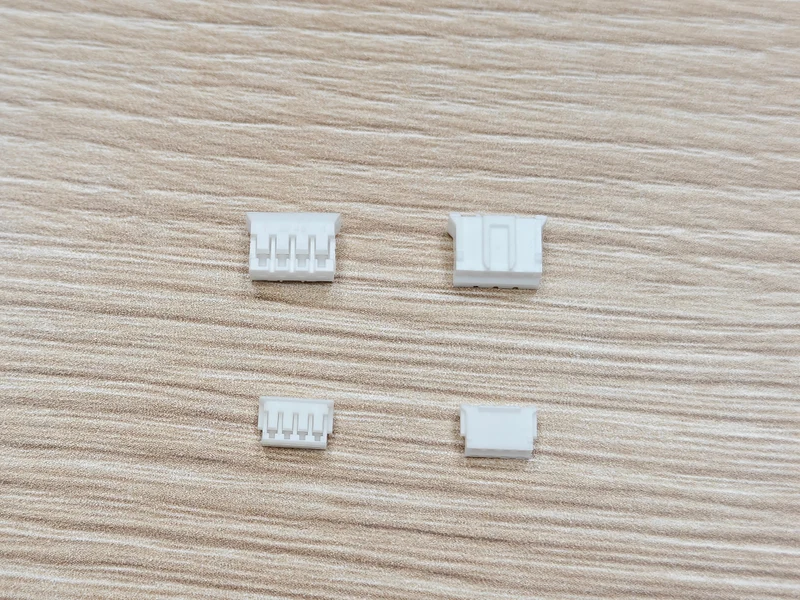
Alternative PH housings (top) and ZH housings (bottom).
Resolve the replacement-part question first
A white four-position housing can be difficult to identify from an unscaled photograph. Measure the contact spacing, not the outside width. Across four positions, ZH spans 4.50 mm from the first contact center to the last; PH spans 6.00 mm. That check narrows the search but does not confirm the correct mating part.
Next, check the header reference, mating-face geometry, polarization and housing drawing. ZHR-4 and PHR-4 identify different housing families. A buyer should not replace one with the other because both descriptions include “4-pin JST.” Preserve the full approved references in the bill of materials rather than shortening them to “1.5 mm plug” or “2 mm connector.”
Record pin numbering from a clearly identified viewing direction. A cable-side view and a mating-face view can make the same circuit arrangement appear reversed. Matching the series and circuit count will not correct a reversed power connection.
Reducing size while keeping a through-hole option
Unlike a comparison in which one series offers only SMT headers, ZH versus PH allows the board assembly method to remain an independent decision. First choose the connector system, then select the exact through-hole or SMT header within it.
For a new through-hole design, review solder-tail length, board thickness, hole layout, mating direction and enclosure clearance together. Do not scale a PH footprint down to create a ZH footprint. For SMT, use the selected header's pad and support-feature drawing; sharing a family pitch does not make all header variants share a footprint.
The packaging benefit also depends on circuit count. Across ten contact centers, the span is 13.50 mm for ZH and 18.00 mm for PH, a 4.50 mm difference. This is a contact-span calculation, not a promise about total housing width or usable board-area savings. Add housing walls, header features, cable exit space and assembly access before comparing the finished envelopes.
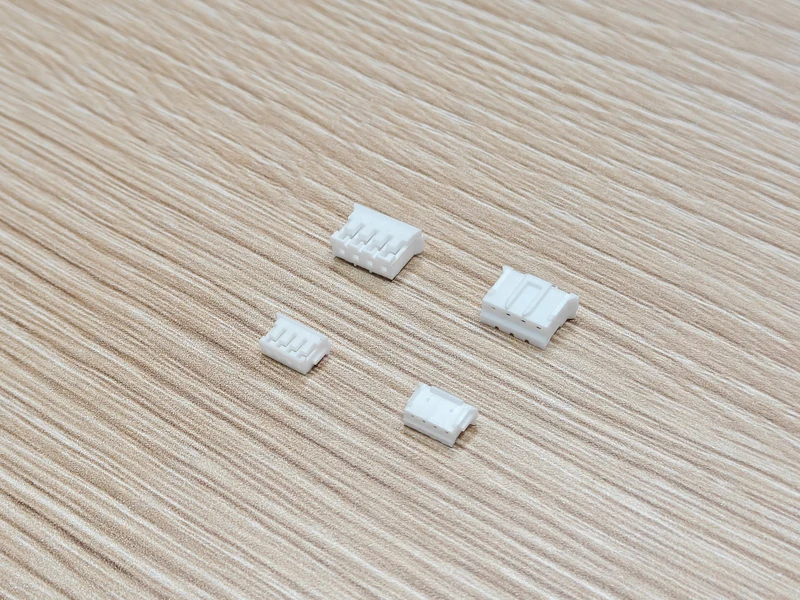
Angled view: alternative PH housings (upper row) and ZH housings (lower row).
A smaller housing must still accept the specified cable
The ZH contact table separates two wire ranges. That detail matters when a purchase specification states only “ZH, AWG 28”: AWG 28 appears in both examples, but insulation OD and the selected terminal determine the applicable combination. State both on the assembly drawing.
An existing AWG 24 PH harness cannot simply receive the listed ZH contacts, whose conductor range ends at AWG 26. Reducing the conductor size is an electrical and mechanical design change. Review cable length, voltage drop, load profile and routing requirements before accepting it.
Likewise, PH's 2 A and ZH's 1 A catalog values are tied to different wire gauges. Do not derive a finished-harness rating by comparing those two numbers alone. Evaluate the actual contact, wire, populated circuits and environment. Current-induced heating is already included in each stated temperature range.
ZH uses a housing lance to retain its contact. This is separate from retaining the mated housing on the header; it is not evidence of a GH-style external positive latch. Where vibration or repeated handling matters, specify the required performance and assess the actual assembly.
Turn the choice into an actionable RFQ
Send a mating reference or controlled drawing, circuit count, pin mapping, wire gauge and insulation OD, cable length and tolerance, entry direction, load and environment. Add quantity, prototype requirements and the inspection or acceptance criteria that matter for your product.
Zeakka sells alternative connectors. Finished harness projects may use original JST components sourced by exact part number and availability, or reviewed unbranded alternatives. Original JST parts are not sold separately. Specific ZH harness configurations and original-part availability require project review.
For a PH assembly, see custom PH cable assemblies. For a ZH/PH comparison, send the application and mating details so the proposed bill of materials can be reviewed.
Frequently asked questions
Will ZH fit a PH board header?
No. The pitch and mating geometry differ. A redesign requires the appropriate header and footprint as well as the cable-side components.
Does choosing ZH require switching to SMT?
No. The cited ZH catalog includes through-hole and SMT options. Select the exact header for the board assembly process and layout.
Can I reuse PH terminals in a ZH housing?
No. An overlapping wire range does not make the contacts interchangeable. Use the contact specified for the chosen housing system.
Is a ZH-to-PH cable possible?
It is a possible connection architecture: each end mates to its own correctly specified header. Define both interfaces and every circuit mapping. Availability of the particular finished assembly needs project review.
What should I compare if ZH is still too large?
Return to the complete envelope and wire requirements, then compare finer-pitch systems in the common JST connector types guide. A smaller pitch may also change current, wire and mounting constraints.
Share this article
Help others discover this content