
Molex Pico-SPOX vs Sherlock: Compact Size, Locking and Design Continuity
Table of Contents
Which interface fits the project?
Pico-SPOX is a 1.50 mm wire-to-board family with a friction-lock interface. Sherlock uses a 2.00 mm interface with positive locking. If you are selecting a new connection, the useful question is whether the smaller interface fits the installation and retention requirements. If you are replacing a cable on an existing board, identify the installed header first: these families are not interchangeable.
Sherlock also needs a part-specific lifecycle check. A connector can match an existing design and still be a poor starting point for a new product if its chosen parts are not recommended for new designs. That decision is separate from dimensions, electrical performance and available stock.
A comparison for cable and board decisions
Scroll sideways to read all columns.
| Selection point | Pico-SPOX | Sherlock |
|---|---|---|
| Mating pitch | 1.50 mm | 2.00 mm |
| Retention approach | Friction lock | Positive lock on the referenced Sherlock interface |
| Illustrative component reference | 874390600: six-circuit receptacle housing | 353620650: six-circuit vertical through-hole header |
| Electrical reference | Family page: up to 3.5 A at 2 circuits / 24 AWG | 353620650 part page: 2.0 A maximum per contact; this is a specific header listing |
| Main design question | Does the smaller interface provide suitable routing, access and retention? | Does the exact mating set meet mechanical needs and the intended product lifecycle? |
| Replacement approach | Match the board header and terminal specification | Match the board header and review exact-part lifecycle status |
The current entries have different scopes and are not a like-for-like harness rating comparison. Molex Pico-SPOX family, 874390600 housing, 353620650 header.
Smaller pitch does not settle the installation
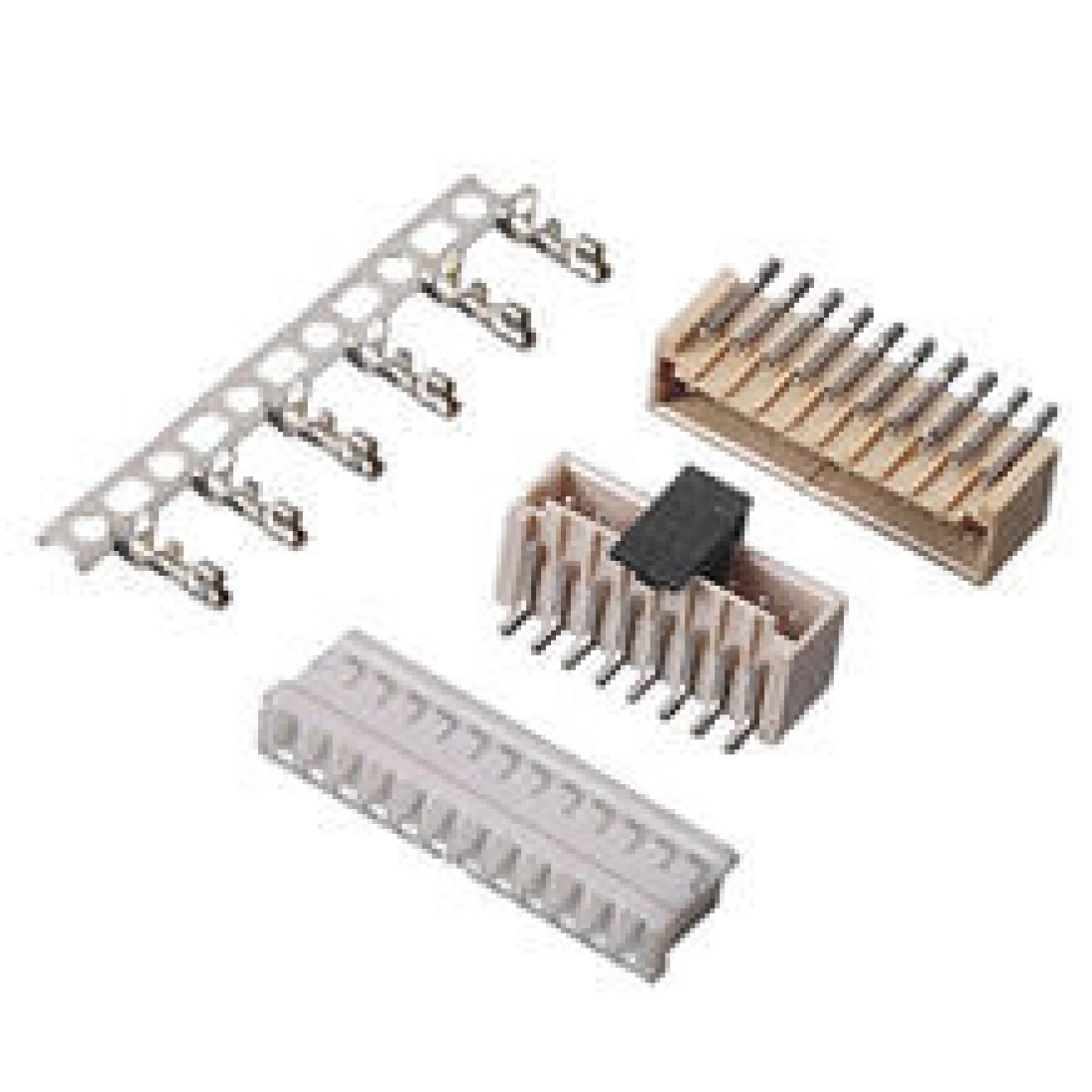
Pico-SPOX alternative catalog components. Shown for identification only; original catalog ratings do not rate these pictured alternatives. View Pico-SPOX alternatives.
Pico-SPOX can be considered when closely spaced contacts are useful, but pitch is only the distance between adjacent contact positions. It does not describe the complete occupied space. Check the selected connector's body, mated height, board footprint and cable exit using its drawing.
A right-angle connection and a vertical connection can need different service clearances even at the same pitch. Allow room to grip the housing, route the wires and disconnect the assembly without pulling directly on the conductors. Include the enclosure wall and neighboring components in the review.
The practical comparison is therefore a pair of drawings inside the proposed enclosure. A catalog photograph cannot show whether an operator will have enough access after final assembly. Where the board is fixed, a smaller cable-end housing from another family will not create a compatible connection.
Friction locking and positive locking answer different needs
Sherlock alternative catalog components. Their appearance does not identify the original parts whose lifecycle status is discussed below. View Sherlock alternatives.
Molex identifies Pico-SPOX as a friction-lock design. The referenced Sherlock headers use positive locking. These mechanisms should not be treated as identical simply because both product pages may indicate a lock to the mating part. Pico-SPOX product guide, Sherlock overview.
For a connection that will be serviced, consider how the operator releases it and where cable loads go after installation. A positive latch may be relevant to retention requirements, but it does not by itself qualify the finished assembly for vibration. A friction-lock interface likewise should not be rejected or accepted without the relevant force limits and application conditions.
Document the retention requirement in practical terms: anticipated cable movement, supporting clips, handling during assembly and service access. Then assess the selected mating set against it. This produces a better decision than labeling one family universally “more reliable.”
Current and wire size must be checked together
Pico-SPOX's current family page states 3.5 A specifically for a two-circuit configuration using 24 AWG. Do not carry that number over to a many-circuit assembly using finer wire. Its ordering guide also separates terminal choices: 87421-0000 covers 24–26 AWG, while 87421-0100 covers 26–30 AWG. A family wire range does not mean every terminal accepts that entire range. Pico-SPOX family ratings, terminal selection guide.
For Sherlock, the 2.0 A field above describes the listed 353620650 header. Determine the allowable assembly load from the applicable mating-system specification, terminal and wire choice, loaded circuits and thermal conditions. Do not describe it as a verified 2 A rating for any Sherlock-style harness.
In either family, include conductor and insulation requirements, simultaneous circuit loading and enclosure temperature in the design review. Component-family names do not establish the temperature rise of a completed cable. Compatible alternatives require their own supporting specifications rather than borrowing original Molex values.
Sherlock lifecycle: check the exact part
At the source check for this draft, Molex lists Sherlock headers 353620650 and 353620850 as Not Recommended For New Design. These are specific six- and eight-circuit references. This statement does not mean every Sherlock part is discontinued, nor does it establish that stock is unavailable. Molex 353620650, Molex 353620850.
For an existing product, confirm the exact parts and supply plan needed to support its remaining life. For a new design, resolve the status of the proposed header, housing and contacts before freezing the interface. If another family is selected, review the board footprint, cable end, pin numbering and enclosure together. Pico-SPOX is a comparison candidate, not a declared drop-in or manufacturer-approved successor to Sherlock.
Discuss the assembly with the correct sourcing assumptions
Zeakka is a sourcing and supply partner. It can coordinate a project review and suitable suppliers; availability and the proposed component source belong in the quotation. Original Molex components may be specified within finished cable assemblies, but Zeakka does not sell original Molex loose components separately. Compatible parts must be identified as alternatives.
See the Pico-SPOX connector reference, Sherlock connector reference and connector alternatives guide. An enquiry should distinguish a cable for an existing header from a new interface selection. That distinction determines whether the board connection is fixed or can be reviewed. Discuss a cable project.
Frequently asked questions
Can Pico-SPOX replace Sherlock without changing the board?
Not as a direct mating replacement. Different pitch and mating geometry require an interface redesign or a separately reviewed transition.
Does a positive latch make Sherlock the better choice?
It may help satisfy a retention requirement, but access, exact-part lifecycle and the validated mating system also matter. Select against the application rather than the latch alone.
Does “not recommended for new design” mean discontinued?
No. Treat it as a part-specific design-selection status. Check current supply and lifecycle information for the exact orderable parts instead of applying it to the whole family.
Related selection guides
Common Molex Connector Types Compared: PicoBlade, Pico-Lock, Pico-SPOX, Micro-Fit, Mini-Fit Jr. and Mega-Fit · Connector Polarization vs Keying: Preventing the Wrong Connection
Share this article
Help others discover this content