
Wire Harness Protection: Braided Sleeving, Split Loom and Heat Shrink
Table of Contents
An exposed wire bundle may need an additional covering where it passes through a crowded enclosure, reaches a branch point or needs protection during installation. The right choice depends on access, available space and the exact protection requirement—not simply which covering looks strongest.
Braided sleeving, split loom and heat shrink are different configurations. They can also be combined on different sections of one harness. This guide compares their installation and maintenance implications; material properties and supply availability must be confirmed for the proposed product.
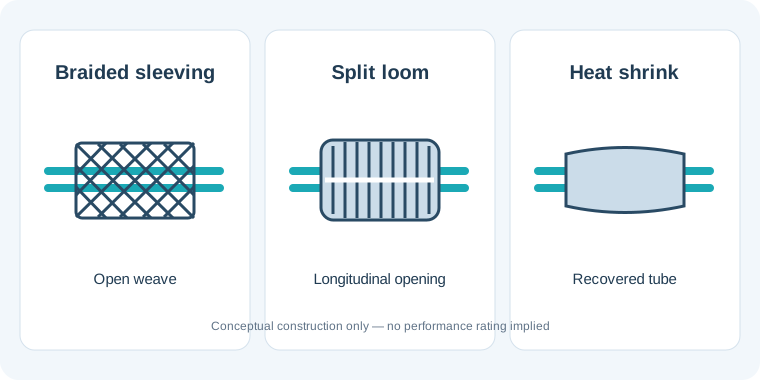
Conceptual illustration only; not a product photograph or evidence of a protection rating.
Define what the covering must do
Mark the areas that need coverage on the harness drawing. Identify contact surfaces, branch exits, connector access and sections that technicians may need to reopen. State whether the covering is intended for bundle organisation, handling protection, a specific abrasion exposure or another defined requirement.
An added covering does not automatically make an assembly waterproof, flame rated or suitable for continuous movement. Those requirements need a specified material, construction and acceptance method. Likewise, a protective sleeve does not replace connector support or strain relief; see our cable assembly strain relief guide.
Compare the installation and service options
Scroll sideways to read all columns.
| Configuration | Installation question | Branch and service considerations | What to specify |
|---|---|---|---|
| Closed expandable braided sleeving | Can it slide over the largest feature, or must it be fitted before termination? | Access usually requires moving or removing the sleeve; plan separate sections at branches | Material, working diameter range, coverage length and end treatment |
| Open or wrap-style braided sleeving | Can the selected design be wrapped around the terminated bundle? | Can allow repeat access; check closure or overlap on the actual bundle | Closure construction, diameter range and retention at ends |
| Slit convoluted tubing, often called split loom | Can the bundle be inserted through the longitudinal opening? | Side access helps installation and maintenance; inspect the slit and branch exits | Material, inside/outside diameter, slit construction and fittings |
| Conventional heat shrink tubing | Does its supplied diameter clear the installation path? | Recovered tubing generally must be removed and replaced for access | Supplied/recovered diameter, wall thickness, material and recovery instructions |
These are construction-level differences. A particular material may have properties that another product in the same category does not have.
Braided sleeving: distinguish closed braid from wrap-style designs
“Braided sleeving” is not one installation method. Closed expandable braid slides along the bundle. Its stated diameter range matters, but a connector housing may still prevent installation. Check the largest cross-section along the installation path rather than using wire diameter alone.
Open woven or wrap-style products are designed differently. For example, HellermannTyton's BSPSW340 documentation describes a lateral split and repeat access to the bundle. That supports treating wrap-style braid as a separate choice, not assuming every braid can be fitted after termination.
Define the cut-edge treatment and end position. Ask for the selected manufacturer's cutting and finishing instructions; do not assume every braid can be heat cut. End retention should avoid obstructing connector latches, labels or inspection areas. Any local heat shrink used to finish a braid end also needs its own installation check.
Split loom: plan the opening, outside size and branch exits
Slit convoluted tubing can accept the bundle from the side. HellermannTyton's CTP1140 product description confirms installation without removing the entire assembly for that design.
Select using both the bundle fit and the available enclosure space. The outside diameter matters at clips and passageways; a nominal size alone is not enough. Also record whether the selected tube is slit or non-slit, because that changes the installation sequence.
At branches, specify where each tube section stops and how exposed transitions are handled. Avoid an undefined instruction such as “cover all wires.” Check that the slit stays in its intended position during the actual installation and that cut ends do not leave an unacceptable contact edge. Fittings, clips or finishing materials are part of the agreed configuration, rather than automatic accessories.
Heat shrink: check clearance before recovery
Conventional heat shrink is a closed tube fitted before heating. It must first clear the relevant bundle, terminal or connector feature. After recovery, it must fit the intended section. A large shrink ratio alone does not prove both conditions are satisfied.
HellermannTyton's heat shrink selection guide distinguishes supplied and recovered dimensions and lists different materials, wall thicknesses and adhesive-lined constructions. Specify those details instead of requesting only “black heat shrink.”
Check the recovery process against nearby wire insulation, connector housings and labels. The finished sample should show the agreed coverage and access, without unintended heat damage. Adhesive-lined tubing is a different construction; its use does not establish an ingress rating for a whole harness or connector interface.
A fictional selection example
Consider a fictional cabinet harness with an accessible main trunk, two serviceable branches and already terminated connectors. A wrap-style braid could be evaluated for the trunk because side installation and later access are useful. Short slit-loom sections could be evaluated where installation handling needs a more defined tubular cover. Heat shrink might be evaluated for a local sleeve-end finish only where it can be installed and recovered safely.
This is an illustration, not a Zeakka product specification or a claim that the combination meets an environmental standard. The drawing, material selection and sample review decide whether it suits the application.
Confirm the specification and sample together
Send the proposed covering type, exact material or reference product, bundle dimensions, coverage start/stop points, branch layout and connector details. Include expected exposure and any required evidence for temperature, flame behaviour, chemical resistance or abrasion performance. Avoid transferring a rating from a similar-looking product.
During sample review, check fit in the real installation, cut-edge finish, closure, branch access, label visibility and the ability to operate connector latches. Record the approved protection configuration with the drawing revision so a later substitution is reviewed explicitly.
Zeakka is a trading and sourcing partner. For a custom discrete-wire cable assembly, send your drawing, bundle details and protection requirements to discuss a proposed configuration. Specific covering materials, finishing methods and supporting documentation are subject to confirmation for the quotation.
Frequently asked questions
Can protection be added after connectors are fitted?
Selected wrap-style braid and slit loom can allow side installation. Closed braid and conventional heat shrink need a clear installation path or fitting before termination. Confirm the exact design and connector clearance.
Does heat shrink make a harness waterproof?
No general waterproof claim follows from adding heat shrink. Material, adhesive, interfaces, installation quality and the agreed test conditions all matter. A harness rating requires evidence for the complete relevant configuration.
Can one harness use more than one protection type?
Yes, different sections can be specified differently. Define transitions, end treatment and access requirements on the drawing, then approve the combination on a representative sample.
Share this article
Help others discover this content