
Specify the cable profile as delivered to the IDC line
Factory-width cable is ordered against a drawing for the target conductor count and finished width. A slit cable starts as a wider parent ribbon and is separated lengthwise into narrower lanes. If the assembly drawing permits a slit lane, qualify its finished dimensions, both edges and conductor identification on the actual termination tooling.
Read the target-width drawing against the machine limit
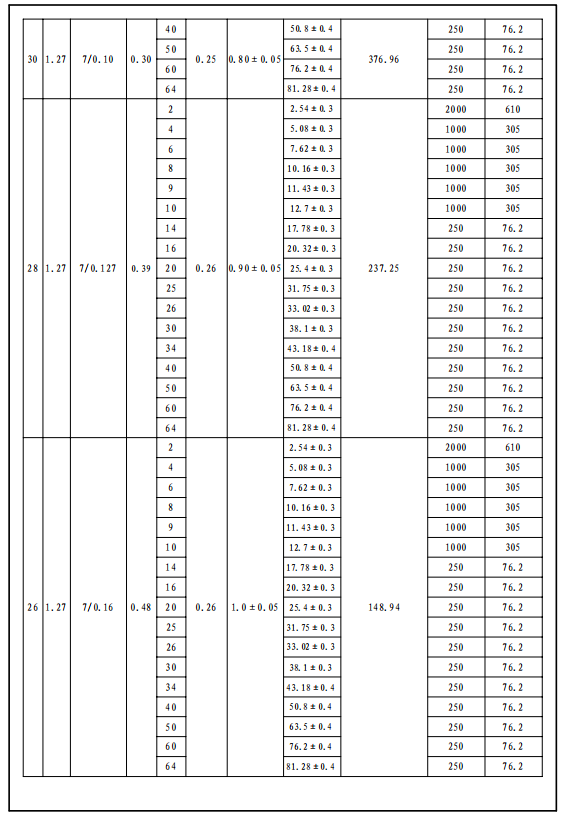
In the 28 AWG, 1.27 mm section of the original drawing, the 40-conductor row lists 50.8 ± 0.4 mm overall width and the 20-conductor row lists 25.4 ± 0.3 mm. The factory-width 20-conductor row therefore has a drawing maximum of 25.7 mm. If the machine owner specifies 25.8 mm as the maximum accepted cable width after allowing for clearance, that row passes the width screen. To evaluate either 20-conductor slit lane from the 40-conductor parent, request its own finished-width range and edge geometry. A parent-width tolerance applies across the entire parent ribbon. View drawing 23.
Agree how to inspect each proposed slit lane
- Edge insulation. Agree a cross-section or other measurement method and acceptance limits for the remaining insulation at the outermost conductors and for edge-to-conductor centre distance. Inspect the slit edge along the length for nicks, exposed copper, tears and loose material. Assign a durable conductor-one reference and record how operators will read it.
- Finished width and feed. Measure overall width and thickness on relaxed samples at several locations. Check the edge-to-centre offsets on both sides and the span across the outside conductor centres. Feed the trial material through the production guide to check for binding, wandering and poor registration at the IDC.
- IDC first article. Use the actual connector part numbers, cable locator, press setup and strain relief. Check alignment at the outer contacts, full cover seating, and correct cable exit and pin mapping. Record continuity and short checks on the finished assembly and any retention or insulation tests the drawing requires. Sample each lane that will be released.
Put the approved conversion on the purchase order
Request separate quotations against the factory-width drawing and the proposed slit-lane specification when both routes are permitted. Compare accepted output after setup, trim, lane losses and inspection. For a slit order, record the parent material revision, converter, approved lanes, finished drawing, edge identification and lot link. Agree when a change to the parent cable, lane, converter or slit setup triggers another first article.
Find factory-width drawing candidates · Check IDC termination requirements