
Brass vs Phosphor Bronze Connector Contacts: What Buyers Should Compare
Table of Contents
“Phosphor bronze contacts” and “brass contacts” describe base-material families, not complete connector specifications. Either description still leaves the alloy, temper, strip thickness, finish and contact geometry unresolved. A quotation that replaces one with the other needs an engineering review of the proposed component, even if the housing and pitch remain unchanged.
The practical purchasing decision is whether the documented contact system meets the equipment's requirements through its intended service life. This guide explains what to compare and what to put in an RFQ; it does not approve a material substitution for a particular connector.
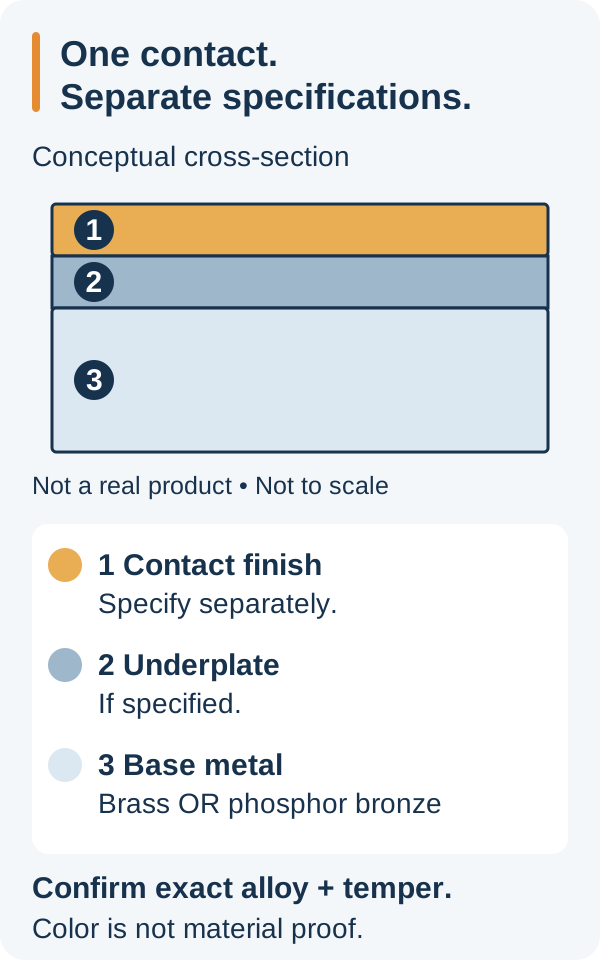
Conceptual illustration, not a product drawing. Layers are not to scale; an underplate is shown only as a separately specified layer.
Separate the base metal from the plated surface
The base metal forms the contact body. Its properties contribute to conductivity, forming behavior and mechanical performance. The mating-area finish is a separate part of the construction. A brass contact can be gold plated, and a phosphor bronze contact can be tin plated. “Gold contact” therefore does not identify the underlying alloy.
TE Connectivity's T2030022015-000 product page illustrates the distinction: it lists brass as the contact base material and gold for the mating-area plating, with a separate underplating field. This is an example of documentation structure, not a recommended part or evidence of Zeakka availability.
Record the base alloy, material condition and required finish separately. For surface selection and mating-pair considerations, use the tin vs gold plating guide. Changing the base material does not remove the need to verify the finish and mating counterpart.
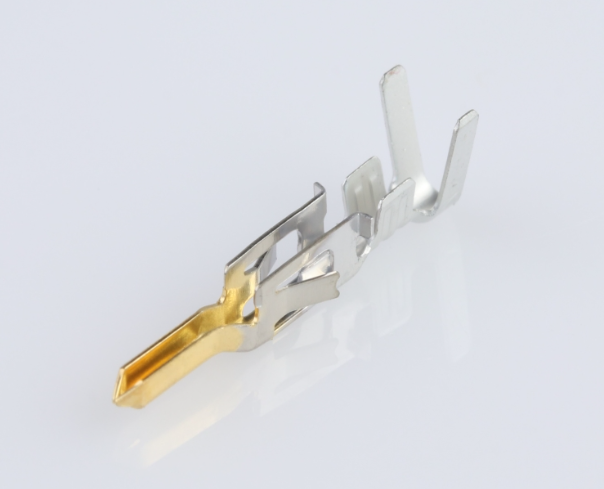
Selective gold plating at the contact area, with tin plating on the remaining areas. This existing product photograph illustrates the surface finish only; it does not identify the base alloy as brass or phosphor bronze.
What do brass and phosphor bronze mean here?
Brasses are copper-zinc alloys. Phosphor bronzes are copper-tin-phosphorus alloys. Each family contains multiple grades, so neither name defines one fixed composition or performance level.
The Copper Development Association identifies C26000 as cartridge brass, with copper specified at 68.5–71.5% and zinc as the remainder, subject to the listed composition limits. It identifies C51000 as phosphor bronze, with 4.2–5.8% tin and 0.03–0.35% phosphorus. These examples explain why an exact alloy designation is useful; they do not describe every connector terminal.
Keep the designation system visible. A shortened local material name or a similar-looking alloy number is insufficient evidence that two specifications are identical. Ask the supplier to identify the governing specification and any claimed cross-reference, then resolve differences before approval.
Start with the contact's mechanical job
A relatively rigid mating pin and a deflecting socket spring have different duties. A spring contact must generate an appropriate contact force when mated and retain adequate force in service. Its alloy matters, but so do its beam dimensions, deflection, forming history and mating geometry.
Wieland's Strip for Connectors brochure describes brass as an economical material family and phosphor bronze as an established choice for spring and signal contacts. It also discusses the tradeoffs among strength, formability, conductivity and resistance to thermal relaxation. Treat those descriptions as a basis for asking better questions, not as a rule that every bronze terminal outperforms every brass terminal.
For an existing connector, preserve the manufacturer's specified contact unless a proposed change has been assessed. Ordering a nominally “better spring material” does not establish the correct contact force, housing retention or wire termination.
Scroll horizontally to read all columns.
| Review item | Brass candidate | Phosphor bronze candidate | Evidence needed for either |
|---|---|---|---|
| Material identity | Specify the actual copper-zinc alloy | Specify the actual copper-tin-phosphorus alloy | Alloy standard, temper and controlled component reference |
| Mechanical role | Assess the particular pin or spring design | Assess the particular pin or spring design | Drawing, mating requirements and applicable test evidence |
| Sustained heat and deflection | Do not assume room-temperature strength predicts retained force | Do not assume the family name guarantees retained force | Relevant time, temperature, stress and material-condition data |
| Electrical duty | Alloy conductivity alone does not assign current rating | Alloy conductivity alone does not assign current rating | Exact connector configuration and thermal performance conditions |
| Finish and termination | Review independently of the alloy name | Review independently of the alloy name | Plating construction, approved mate and wire/tooling requirements |
Read stress-relaxation claims with their conditions
A spring held at a fixed deflection can lose force over time. That is a different question from whether it survived one insertion or met a room-temperature tensile-strength value.
Materion explains in What Is Stress Relaxation of Materials? that relaxation depends on time, temperature and initial stress, with alloy, temper and material orientation also affecting the result. A retained-stress percentage is therefore incomplete without its test conditions.
When a supplier provides a relaxation curve, record the exact alloy and temper, specimen orientation where relevant, temperature, exposure duration and initial stress definition. Ask whether the data describes strip specimens or the finished contact, and how it supports the proposed terminal's application. Do not transfer a result from another temper or from a lower-temperature test without justification.
There is no universal operating-temperature limit for “phosphor bronze contacts” or “brass contacts.” The finished connector also contains a housing, plating and terminations with their own constraints. Obtain the rating and qualification conditions for the actual part rather than assigning it the highest temperature mentioned in a material brochure.
Conductivity is one input to current performance
A material comparison can help explain differences in bulk resistance. It cannot establish an allowable connector current by itself. The current path also depends on contact geometry, the mating interface, wire size, populated circuits and the assembly's thermal environment.
Do not conclude that phosphor bronze is unsuitable for carrying current, or that a brass terminal automatically carries more current, from an isolated conductivity figure. Review the specific connector's rating and test conditions. The connector current-rating guide explains why the complete configuration matters.
If a proposed substitution changes material but keeps the same advertised current, request the candidate's supporting documentation. An original connector's test result does not automatically qualify an alternative with a different construction.
A useful supplier comparison starts with two controlled references
Consider this illustrative review: an approved drawing specifies terminal A, while a quotation offers terminal B described as phosphor bronze instead of brass. These are fictional identifiers, not product recommendations.
Before comparing price, request B's full part reference and drawing. Identify changes to the alloy, temper, dimensions, plating, wire range and applicable tooling. Then ask the responsible engineer which acceptance evidence must be repeated or supplemented. A continuity check confirms an electrical path at the time of measurement; it does not by itself establish long-term contact-force retention or durability.
If the supplier cannot identify the alloy or material condition, record that uncertainty. Do not rewrite “copper alloy” as a specific bronze grade in the purchase order to make the quotation look complete. For a change to an approved assembly, keep the decision tied to the engineering-change record.
What to include in the RFQ
Provide the existing terminal, housing and mating-part references; the assembly drawing revision; wire construction and size; electrical loading; local temperature and exposure duration; vibration or movement; and expected mating events. State which requirements are fixed and whether alternatives may be proposed.
Ask the quotation to identify the candidate terminal and its material/finish documentation, relevant performance evidence, deviations from the baseline and unresolved items. Request material certificates or lot traceability when your purchasing specification requires them, rather than assuming they accompany every order.
Zeakka is a trading and sourcing partner. Send the component references and application requirements for supplier coordination within a cable assembly project. Material examples in this guide do not confirm any particular alloy, temper or contact option as available; proposed constructions and evidence must be established for the selected project.
Frequently asked questions
Is phosphor bronze always better than brass?
No. Select against the actual contact design, service conditions and documented performance. A qualified brass contact that meets the application does not require replacement merely because another quotation names phosphor bronze.
Can plating make two different base metals equivalent?
A matching finish does not establish equivalent spring, forming or electrical behavior. Compare the base material and finished contact separately, while retaining the required plating construction.
Can I identify the material from a photograph?
A plated surface can hide the base material. Use the controlled drawing, material specification and any required supporting records; appearance alone cannot verify the alloy or temper.
Share this article
Help others discover this content