
Tin vs Gold-Plated Connector Contacts: How to Choose
Table of Contents
Start with the finish specified for the existing mating connector. A gold-plated terminal is not automatically an upgrade for a tin-plated interface, and a family name does not identify the plating on every terminal option. The decision concerns the complete contact pair, its operating conditions and the documentation for the exact parts.
For cable procurement, the useful question is not simply “tin or gold?” It is whether the proposed terminal and mating part form an approved connection for the equipment's electrical, environmental and service requirements.
Identify the area being plated
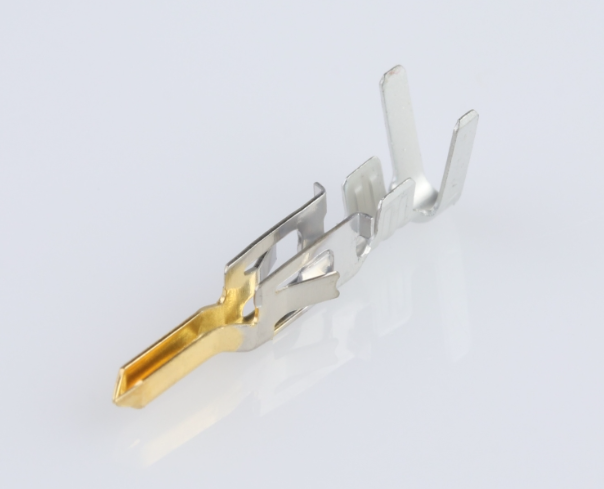
Selective plating example: gold at the mating contact area and tin on the remaining areas, as confirmed for this sample. No specific part number or plating thickness is identified.
The mating area touches the opposite contact. The termination area connects to the wire or PCB. These areas can have different finishes on the same component. A gold mating surface with a tin solder tail is therefore different from mating a gold contact against a tin contact.
Molex Nano-Fit part 2264712212 lists gold for its mating area and matte tin for its termination area. These are separate finish fields on one component, not permission to mate gold against tin. Use the applicable drawing to establish the complete finish construction. Molex 2264712212 finish fields
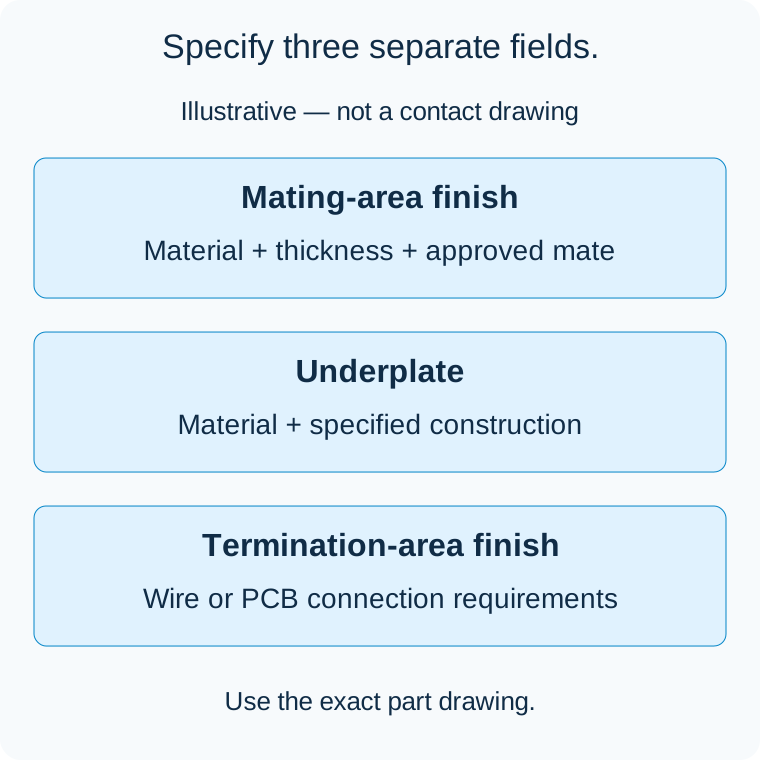
Illustrative specification checklist, not product geometry or a microscopic cross-section. Each field must come from the selected component's documentation.
Do not infer these fields from a photograph. Color cannot establish plating thickness, underplate, selective-plating boundaries or conformity to the drawing. Ask for the complete terminal part number and its applicable drawing revision.
What changes when you choose tin or gold?
Tin often offers a cost advantage. It forms an oxide film, so the contact's force and wiping action must establish the intended electrical interface through that film. Movement at the contact can create fretting-related problems; the connector design and application conditions matter as much as the finish name. Gold resists surface oxidation, making it worth evaluating where stable low-level contact behavior or environmental exposure is important. That does not make every signal circuit require gold. Samtec connector-plating explanation
Gold also needs an appropriate construction: pores can expose underlying material, and wear can change the surface during use. Thickness and underplate therefore remain relevant when reviewing an exposed connection or repeated maintenance. A thin coating cannot be assumed to behave like another qualified gold option. Select against the specified environment and service pattern rather than treating color or price as a performance grade. Samtec corrosion and plating discussion
Compare the questions each finish must answer
Scroll sideways to read all columns.
| Selection question | Tin-plated candidate | Gold-plated candidate |
|---|---|---|
| Existing mating part | Confirm an approved finish pairing; do not substitute based on price alone | Confirm the opposite contact is approved for that gold option |
| Surface behavior | Oxide film makes contact force and wipe important | Oxidation-resistant surface; assess the actual plated construction |
| Cost and environment | Often economical; evaluate movement and exposure in the selected system | Higher finish cost may be justified by application needs; porosity and wear still matter |
| Connection frequency | Use the exact pair's durability data | Do not assume a higher cycle rating just because the finish is gold |
| Purchasing evidence | Identify the finish option in the terminal and mate references | Identify the finish option and specified plating construction |
The table is a review framework, not a universal ranking. A documented tin contact system that meets the application can be a better purchasing decision than an unspecified gold-colored replacement.
Keep the two mating surfaces compatible
Use the selected connector manufacturer's pairing instructions. For example, Molex's Ultra-Fit application specification 1723230003, revision C1, identifies its covered series in section 2 and explicitly requires gold-to-gold or tin-to-tin mating in section 4. That is a requirement for the covered system; do not interpret a mechanically successful insertion as permission to cross-mate finishes. Molex Ultra-Fit application specification, pages 1–2
For an existing board, obtain the header's exact part number before specifying the cable terminal. If the board-side finish is unknown, record it as an unresolved selection input. Ordering a different cable finish first can create a compatibility problem that the housing drawing alone will not reveal.
The same discipline applies to alternatives. Matching pitch, terminal shape or apparent color does not establish an approved material pairing. The connector-alternative verification guide explains how to separate mechanical fit from evidence for the proposed connection.
Read thickness and underplate as part of a construction
A plating description should identify the material, the relevant area, the thickness requirement and any specified underplate. Preserve whether the document gives a minimum, a range or another defined value. Do not replace that language with an unqualified thickness claim in the purchase order.
Thickness alone cannot establish contact performance. The contact geometry, force, mating surface, operating environment and documented test conditions also matter. Nor should a coating described as gold flash be silently substituted for a different specified gold construction because both look similar.
Keep units explicit when comparing quotations. A value in micrometres and a value in microinches are not interchangeable numbers. If two suppliers describe the finish differently, resolve the drawing requirements before accepting the proposals as equivalent.
Define the application without inventing a universal threshold
Describe the circuit's electrical duty, local environment, expected connection events and any relevant movement at the interface. Let the responsible engineering team compare those requirements with the exact component documentation. There is no single current, voltage or pitch threshold that selects the correct finish for every connector.
Likewise, plating selection does not replace wire-size review, thermal assessment or mechanical protection. A gold option is not permission to exceed the contact's current conditions, and a tin option is not automatically unsuitable for all signal circuits. Require evidence for the intended use rather than a blanket material rule.
When changing a finish in an approved assembly, treat it as a component change. Review the mating counterpart, part-number suffixes, applicable qualification evidence and affected acceptance requirements before updating the drawing. The engineering-change guide helps define that review without automatically repeating unrelated tests.
Specify the pair in the quotation request
Provide the cable terminal and equipment-side mating references, their drawing revisions, required finishes and any unresolved information. State whether alternatives may be proposed and what evidence the engineering reviewer needs to accept them. Do not request “gold plated” as a substitute for defining the complete interface.
Zeakka coordinates component and supplier sourcing as a trading partner. Original branded components are considered for finished cable assemblies, not loose-component sales. An alternative must be assessed against its own proposed construction and evidence; original-component specifications do not automatically rate it. Send the interface details for a project review, including any finish requirement that must remain fixed.
Related selection guides
Connector Mating Cycles Explained: Choosing for Assembly and Maintenance · Connector Current Ratings Explained: Wire Size, Circuit Loading and Temperature Rise
Share this article
Help others discover this content