
Connector Housing Materials: PA66, PBT, LCP and UL 94
Table of Contents
“PA66, UL 94 V-0” is a useful starting point for a connector-housing discussion, but it is not a complete purchasing specification. PA66 identifies a polymer family. V-0 identifies a flammability classification under a particular test method and conditions. Neither statement establishes the full material construction, finished connector rating or suitability for your equipment.
For a cable assembly, start with the selected connector reference and application requirements. Then ask which resin grade supports those requirements and what evidence connects that grade to the proposed housing. This guide covers that review, rather than prescribing one plastic for every connector.
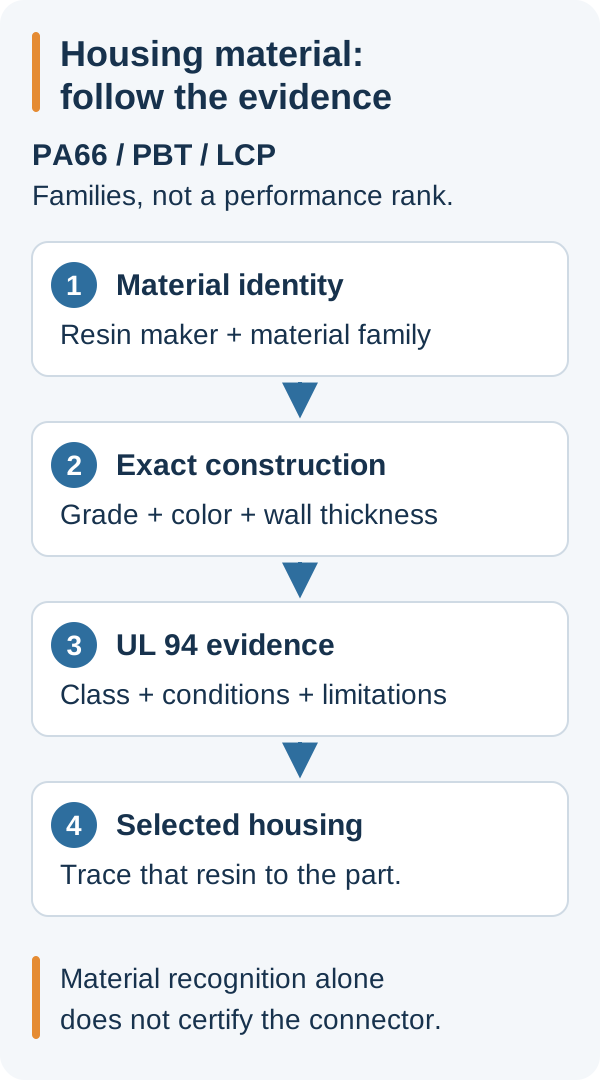
An evidence-review sequence, not a material ranking or certification record. Check the selected resin and component rather than assigning a rating from a polymer family name.
Identify the part whose material you are comparing
The cable-side housing and PCB-mounted connector body may use different materials. The board part may encounter soldering heat that the separate cable housing never sees. A family-level catalog description can also cover several variants with different resin or reinforcement options.
Record the exact housing and mating-part numbers, including relevant suffixes and drawing revisions. Keep the cable housing, board insulator and any separate retainer or seal distinct in the BOM. The housings, terminals and headers guide explains these component boundaries.
A photograph cannot verify the polymer grade, flame classification or approved molding formulation. A PA66 marking, where present, identifies a material family; it does not provide the full evidence required for the finished component.
PA66: compare the moisture condition as well as the grade
PA66 is polyamide 66, often called nylon 66. Its mechanical properties need to be read with the moisture condition attached. BASF's Ultramid PA brochure explains that freshly molded polyamide parts absorb moisture according to ambient conditions, changing their mechanical behavior. This is why datasheets distinguish dry and conditioned values.
For purchasing review, compare the same property under comparable temperature, conditioning and test conditions. Do not compare one grade's dry stiffness with another grade's conditioned stiffness as if the figures described the same state.
Ask which moisture condition is relevant to the latch, contact-retention features and dimensional checks in your application. The useful response is a grade-specific assessment and component evidence. It is not a blanket instruction to dry or condition every delivered housing yourself.
PBT: low water uptake does not mean immunity to hot water
PBT is polybutylene terephthalate. BASF describes low water absorption and dimensional stability among the characteristics of its Ultradur PBT range. These properties can make a PBT grade worth considering when dimensional behavior across humidity conditions matters.
However, low moisture absorption and hydrolysis resistance are different questions. BASF's Ultradur product brochure warns that polyesters can be damaged by hydrolysis and identifies hydrolysis-resistant grades for relevant long-term exposure. A generic PBT label does not establish suitability for sustained hot, wet service.
Describe the actual exposure: humidity, condensation, splash or immersion; temperature and duration; and any cleaning chemicals. Ask for data relevant to the proposed grade and component. Do not turn an unspecified “chemical resistant” claim into approval for every fluid used in your process.
LCP: review thin sections, heat exposure and molded-part design
LCP means liquid crystal polymer. Celanese's Vectra LCP design guide identifies flow into thin sections, dimensional accuracy and heat resistance as reasons to select LCP for electrical connectors. The same guide discusses directional properties and weld-line behavior, which keep grade and part design central to the decision.
Celanese also identifies low moisture uptake and dimensional stability after reflow among the characteristics of its LCP products for mobile-device components. That supports considering a documented LCP option for a suitable board component; it does not approve every LCP connector for an arbitrary soldering profile.
Obtain the selected connector's permitted soldering method, peak conditions, exposure duration and other applicable handling requirements. Keep those short process exposures separate from continuous operation. A melting point, heat-deflection value or reflow claim is not a universal service-temperature rating.
Compare questions, not just polymer names
The following table is a selection framework. It does not rank every grade within these families or describe confirmed Zeakka supply options.
Scroll horizontally to read all columns.
| Material family | Useful review focus | What the family name leaves unresolved |
|---|---|---|
| PA66 | Moisture-dependent mechanical and dimensional behavior | Grade, reinforcement, conditioning, flame classification and finished-part performance |
| PBT | Dimensional behavior and the actual wet/chemical exposure | Hydrolysis resistance, formulation, temperature conditions and component approval |
| LCP | Thin-section molding and documented thermal-process suitability | Grade, directional behavior, critical molded features and allowed soldering profile |
Glass reinforcement, flame-retardant systems and other formulation differences can change the relevant data. Preserve the full resin designation and documented material options when comparing quotations. Do not reduce a controlled grade requirement to “nylon” or “plastic V-0.”
What UL 94 does establish
UL 94 evaluates the burning behavior of plastic materials under controlled, small-scale test conditions. UL's explanation of UL 94 ratings and limitations distinguishes the horizontal HB and vertical V test arrangements. The classification concerns the evaluated material behavior; it is not a statement that a connector cannot burn or that an equipment assembly is fireproof.
A V-0 material claim also does not assign a connector's current, voltage or continuous operating temperature. Those requirements need their own applicable evidence. Do not treat a material flammability classification as whole-connector certification or finished-equipment approval.
Check the grade, thickness, color and recognition scope
UL's Yellow Card brochure explains that a material card records tested properties and conditions of acceptability. Its example separates material designation, color, minimum thickness and flame class, alongside other property fields.
When a supplier proposes “UL 94 V-0 housing material,” request:
- The resin manufacturer's name and complete grade designation.
- The relevant current material recognition record or test evidence, including its identity and scope.
- The flame-class entry and thickness condition applicable to the proposed construction.
- The color coverage and any applicable limitations or footnotes.
- Evidence identifying that resin in the offered housing, rather than merely a card for a material the supplier could purchase.
UL's color-code guidance distinguishes entries such as ALL, NC and BK, and defines the minimum-thickness field. Check the actual entry. A natural-color listing is not evidence for every colored version.
If the proposed component contains a relevant wall thinner than the documented rating condition, keep that applicability question open for the responsible technical reviewer. Do not simply copy a thicker specimen's rating onto the thinner part. Changing color, grade or formulation also calls for checking whether the supporting evidence still applies.
Keep flammability, tracking and temperature evidence separate
The UL Yellow Card presents flame class, relative thermal index and tracking-related information as separate fields. They answer different questions. A flammability result cannot substitute for the electrical and thermal assessment required by the end product.
For an existing equipment design, ask the design authority which properties and certifications must remain fixed. If a proposed alternative has the same pitch and V-0 wording but a different resin or construction, compare the actual evidence before acceptance. The connector-alternative verification guide covers the broader interface review.
Put the requirement into a reviewable RFQ
Supply the housing and mating references, assembly drawing revision, service temperature and duration, humidity or fluid exposure, mechanical demands, and any board soldering constraints. Identify the required material properties and the end-product requirements that drive them. Where the exact grade must remain fixed, say so; where alternatives are allowed, require the proposed grade and deviations to be declared.
Ask for evidence tied to the offered component, plus an approval process for later resin, formulation or color changes. A successful initial fit check does not close material-aging or recognition questions. Keep those items visible in the sample approval record.
Zeakka coordinates sourcing and supplier review as a trading partner. Send the component references and material requirements for a cable assembly project. This guide does not confirm that Zeakka manufactures housings, offers every material listed, or holds a connector or resin certification. Availability and supporting documentation must be established for the selected construction.
Frequently asked questions
Is PA66 always UL 94 V-0?
No. The polymer family alone does not assign the flame class. Check the exact grade, thickness, color and applicable evidence.
Is LCP always better than PBT or PA66?
No. Select the documented component for its installation and processing requirements. A different polymer name alone does not establish a useful upgrade or interchangeability.
Does a UL Recognized resin make the entire connector UL certified?
Material recognition provides evidence within its stated scope and conditions. Any claim about the connector or finished equipment needs the applicable product-level evidence and must not be inferred solely from the resin card.
Share this article
Help others discover this content