
How to Verify JST and Molex Connector Alternatives
Table of Contents
A connector alternative is a proposed change to a defined connection, not a conclusion established by matching the pitch. A housing can look familiar and still differ in contact position, polarization, terminal retention or the space needed to operate its latch. Start with the exact existing assembly and decide what evidence is needed before buying the replacement.
This guide covers a review process for unbranded alternatives to named JST or Molex components. It does not identify an unknown connector from a photograph or rank one series against another. Use the JST connector types guide to narrow a family; use drawings and the actual mating arrangement to assess a particular proposal.
Define exactly what is being replaced
Separate three changes that are often described with the same word, “equivalent.” Replacing a complete cable assembly while retaining the equipment header is different from changing both mating halves. Substituting only a terminal inside an existing housing is a third, separate configuration. Approval of one does not approve the others.
Record the original housing, terminal and mating-part numbers, including suffixes, circuit count and populated positions. Add the equipment drawing revision and any approved options. If the original part is uncertain, label the identification as provisional. A supplier cross-reference is a useful starting point, not evidence that every dimensional, electrical and processing requirement is interchangeable.
Compare evidence before ordering samples
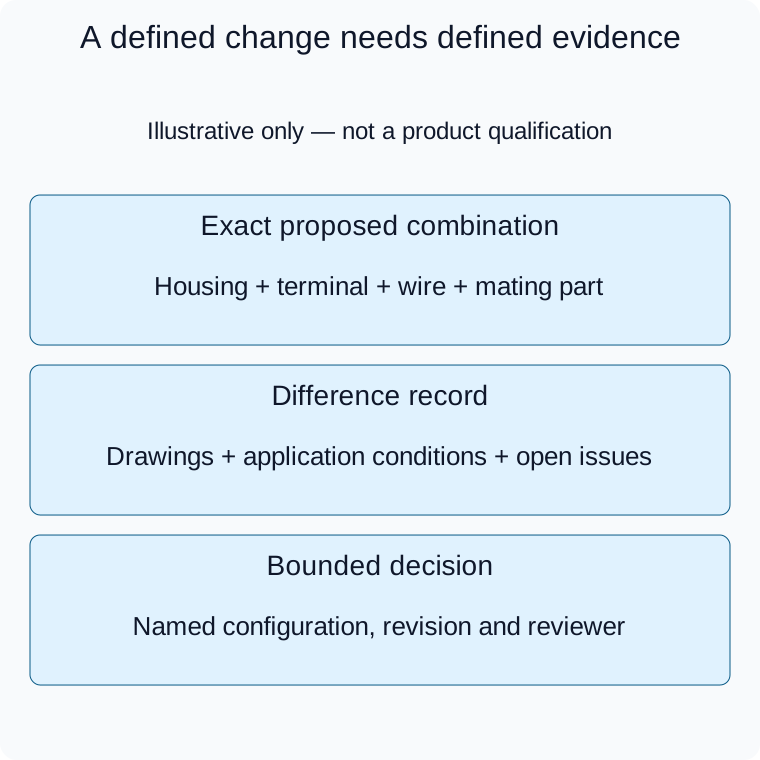
A review structure, not proof that any connector pair is interchangeable.
Request the proposed supplier's exact references and controlled drawings. Put them beside the original documents and make a short difference record. “Same as JST” is not a substitute for identifying which features were checked and which remain unknown.
Scroll sideways to read all columns.
| Review area | Evidence to compare | A question that prevents a false match |
|---|---|---|
| Mating interface | Contact geometry, row layout, engagement and polarization dimensions | Does the proposed part match the exact equipment-side counterpart? |
| Housing and retention | Latch location, terminal retention features and any secondary lock | Are all required retention features present and usable? |
| Assembly envelope | Overall dimensions, exit direction and access space | Can an operator fully mate and release it inside the actual enclosure? |
| Termination | Terminal reference, accepted conductor and insulation range, processing specification | Is the selected wire approved for this exact terminal and process? |
| Materials and contact finish | Supplier material and plating specification | What changes from the approved construction, and who will assess the change? |
| Electrical and environmental use | Supplier ratings with conditions, application requirements and supporting evidence | Does the evidence cover this assembly and operating situation? |
Do not transfer an original manufacturer's current rating, temperature limit, durability statement or approval mark to an alternative simply because its housing has a similar outline. A report is only useful when its product identity, revision, conditions and acceptance criteria correspond to the proposal. Where the comparison leaves a gap, record it as unresolved rather than filling it with the original catalog value.
Treat mixed-brand mating as a specific decision
JST's handling precautions, pages 2–3, distinguish component specifications from suitability in the finished equipment and state that JST does not accept responsibility for performance when its products are combined with non-JST terminals or connectors. An original header plus an alternative cable-side housing is therefore not automatically covered by the original connector's performance claim.
A useful example of why details matter appears in the Molex Micro-Fit+ application specification. It specifies matching contact-finishing systems and warns against incorrect polarization. These are requirements for that identified system, not universal rules for every connector sold under a Molex cross-reference. Review the applicable documents for the exact proposed combination.
Ask the equipment owner or responsible engineer whether mixed-brand mating is permitted, what evidence is required and who can approve it. If that authority is not available, a supplier's statement that the parts “fit” should not close the decision.
Check the actual assembly, not just loose housings
Use identified samples made to the proposed wire, terminal and housing configuration. Compare them with the actual specified counterpart, following the applicable handling instructions. Do not force an apparently similar connector into place to prove interchangeability.
Observe full engagement, latch access, contact seating and cable routing in the equipment. Check whether the installation places a side load on the connection or prevents release for service. A successful first insertion cannot establish durability, temperature rise or environmental performance.
Verify the wiring against the approved pinout and viewing convention. Neither matching wire colors nor a familiar cavity layout proves the electrical mapping. Define any additional validation with the project owner before drawing conclusions; the cable assembly testing guide separates routine continuity checks from other mechanical and electrical evaluations.
Record a bounded approval
Keep the comparison, sample identity and decision together. A useful disposition states the accepted supplier references, mating counterpart, wire configuration and drawing revisions; it also records deviations, unresolved conditions and the person authorizing use. “Sample approved” without those references is difficult to apply when the next quotation or shipment changes.
The following outcomes are different: approved for the specified configuration; approved only for a limited evaluation; and not approved pending identified evidence. State which applies. A later change to the terminal, plating, resin, wire or mating part should trigger review of the affected evidence rather than being silently treated as the same approved assembly.
Request an alternative with a reviewable scope
Browse JST connector alternatives or Molex connector alternatives, then send the exact reference, mating part, drawing and application requirements. Mark any features that must remain unchanged and identify whether alternatives are permitted at the housing, terminal or complete-assembly level.
Zeakka is a trading and sourcing partner. We can coordinate review of unbranded alternatives, or sourcing of original JST or Molex parts for finished cable assemblies subject to exact part selection and availability. Original-brand components are not sold separately. This sourcing role does not establish automatic cross-brand compatibility or transfer an original manufacturer's qualification to an alternative.
Contact Zeakka with the configuration and the open questions. The useful result is a documented proposal that your responsible engineering team can evaluate, with any remaining evidence agreed before production.
Share this article
Help others discover this content