
Intermittent Open Circuits in Cable Assemblies: Recording the Conditions
Table of Contents
An intermittent connection report should preserve the event, not replace it with the last result seen on a screen. A cable may pass a later stationary check even though an earlier interruption remains unexplained.
The useful first deliverable is a clear incident record: the assembly identity, the observed symptom, the conditions already present and the configuration used for any subsequent check. That information helps a qualified reviewer distinguish an assembly question from a fixture, equipment or test-coverage question.
Keep the original event alongside the later test result
Fictional EX-IF-34 timeline: an equipment interruption at 09:12, authorized isolation and removal at 09:25, a stationary pass at 10:10, and an unresolved investigation at 10:20. A later pass does not erase the initial event.
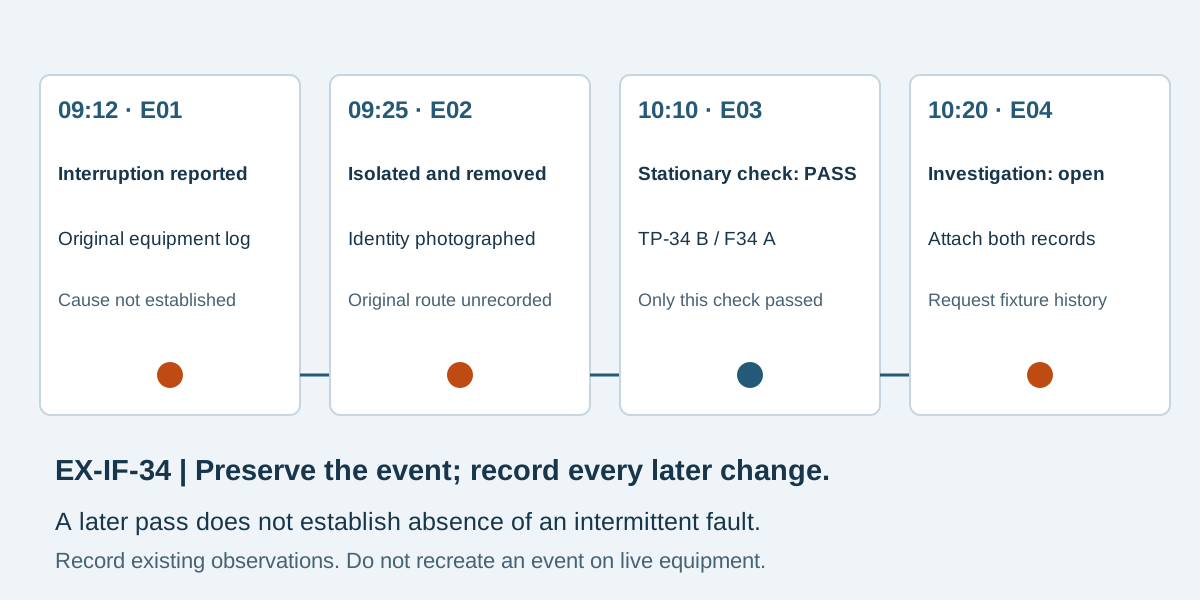
Conceptual illustration. Fictional examples are not approved product configurations, tooling instructions or inspection results.
Separate the observation from the diagnosis
“Equipment stopped when the cover moved” is an observation. “The crimp is defective” is a proposed explanation that requires evidence. An application alarm may not even identify an electrical open circuit; it can indicate a wider system condition.
Use the exact instrument or equipment message when available. Record which channels or endpoints it identifies and whether the message is an application alarm, a continuity failure, a measured resistance change or an operator impression. Preserve logs and photographs with their timestamps rather than rewriting them into a more definite diagnosis.
Avoid turning movement near a connector into proof of a fault inside that connector. The same movement may affect another cable section, fixture interface, mounting point or equipment connection. Record the location observed and leave the cause unassigned until the evidence supports it.
Make the situation safe before gathering more evidence
Do not deliberately move, disconnect or probe a live assembly to recreate an interruption. Follow the equipment owner's isolation procedure and have qualified personnel determine whether investigation can proceed. Stored energy and connected equipment remain relevant even after an ordinary power switch has been turned off.
An incident report can be prepared from existing logs, part labels, installation photographs and operator observations without recreating the event. If a controlled reproduction is required, the responsible technical team must define the equipment state, safe setup, permitted actions, instruments and acceptance criteria. This article supplies a record structure, not a live fault-finding procedure.
Keep the affected unit identifiable and prevent uncontrolled rework. Cleaning, reseating, tightening or replacing parts can change the condition being investigated. Record any intervention already made, including by whom and when, so a later pass is not mistaken for a result on the original untouched configuration.
Capture the minimum event record
Scroll sideways to read all columns.
| Record field | Useful detail |
|---|---|
| Unit identity | Assembly number, revision, lot or serial ID and equipment location |
| Original event | Timestamp, exact symptom or alarm, affected function and retained log |
| Conditions already present | Operating state, installed route and any observed motion or environmental change |
| Known configuration | Mating component, attachment points and relevant equipment revision |
| Subsequent check | Procedure, instrument, program, fixture identity and test conditions |
| Intervention history | Reconnection, repair, cleaning, part substitution or other changes |
| Evidence and status | File references, unresolved questions and assigned reviewer |
If a field was not recorded, write “not recorded.” Do not reconstruct a temperature, duration or load from memory as though it were a measurement. If the photograph was taken after the cable was removed, identify it as an after-removal photograph.
A fictional event log that preserves uncertainty
EX-IF-34 concerns assembly EX-CA-34, revision B, unit U017. The following sequence is invented to illustrate documentation; it is not a Zeakka service case or a test instruction.
Scroll sideways to read all columns.
| Event | Available observation | What it does not establish |
|---|---|---|
| E01, 09:12 | Equipment log reports signal interruption while an operator opens a cover; installed cable position was not photographed | Which connection failed, or whether a cable caused the alarm |
| E02, 09:25 | Authorized staff isolate the equipment; U017 is removed and its identities photographed | The original routing or contact state before removal |
| E03, 10:10 | Stationary wiring check under procedure TP-34 B records PASS using fixture F34 A | Absence of an intermittent event under every operating condition |
| E04, 10:20 | Original alarm log and test record are attached to investigation IR-34; fixture verification history requested | A confirmed root cause or release decision |
The record should retain E01 even though E03 passed. The correct summary is “reported interruption; later stationary check passed; cause unresolved.” Calling the cable either proven defective or proven fault-free would exceed this evidence.
This sequence also shows an evidence gap: removal changed the installation before a routing photograph was taken. Record the gap. Do not recreate an assumed original route and present the new photograph as the initial condition.
Record what the tester could actually observe
A result is bounded by its method and observation period. Ask whether the setup performed a single check, repeated checks or a mode designed to retain intermittent events. Record the actual program and relevant settings through the responsible test team. Do not assume that the word “continuous” defines a universal detection capability or minimum event duration.
Cirris discusses intermittent-error detection and explains that tester configuration and fixture condition affect what is found. It also warns against accepting a setup merely after manipulation produces a good result. That supports retaining an earlier failure and reviewing the test method; it does not supply a generic reproduction procedure for installed equipment.
The cable testing guide explains the narrower meaning of a stationary wiring result. If a specialist establishes a controlled investigation, preserve the observation window, event capture behavior and untested conditions in the report. A failure that was not reproduced should be described that way.
Include the fixture and the installed interfaces
Request the fixture ID, verification status and recent repair or replacement history when a bench test is part of the evidence. A fixture contains its own contacts and wiring, so its condition must be considered without assuming it is the cause.
Likewise, retain the identity of the equipment-side mating part and document visible installation conditions without disturbing them unnecessarily. Use the test fixture requirements guide for the interface record. Changes made during investigation should be individually traceable so the reviewer knows which configuration produced each result.
Frequently asked questions
Does a later continuity pass close the incident?
No. It records a result under the later conditions. The earlier event, changed configuration and any untested conditions still need a documented disposition.
Can the fault be assigned to a crimp because movement affected the symptom?
Not from that observation alone. Record where movement was seen and let qualified review determine which evidence can distinguish possible causes.
What should be sent if the interruption cannot be reproduced?
Send the original event record, assembly identity, configuration, subsequent checks and intervention history. State “not reproduced under the recorded conditions” and identify missing evidence.
Request review with the evidence intact
For a cable assembly supplied through Zeakka, contact the team with the unit identity, original logs and event sequence. Zeakka coordinates the relevant supplier review as a trading partner. Any further test or corrective action needs an agreed scope; an event description alone cannot establish the root cause.
Share this article
Help others discover this content