
Cable Assembly Quality Issue Report Template
Table of Contents
A useful cable assembly quality report begins with an identifiable observation: which unit showed what condition, where it was found and what happened before the observation. That record gives the supplier a starting point without turning a suspected cause into an established fact.
This editable template organizes the first evidence package and follow-up actions. It includes a blank report and a completed fictional example with an open issue, retained specimen and continuing hold. It does not claim to complete a root-cause investigation or an 8D process.
Connect the observation to evidence and the next decision
Fictional EX-QI-31. Recording containment does not confirm a cause or release the stock. The issue retains open actions and a named decision owner.
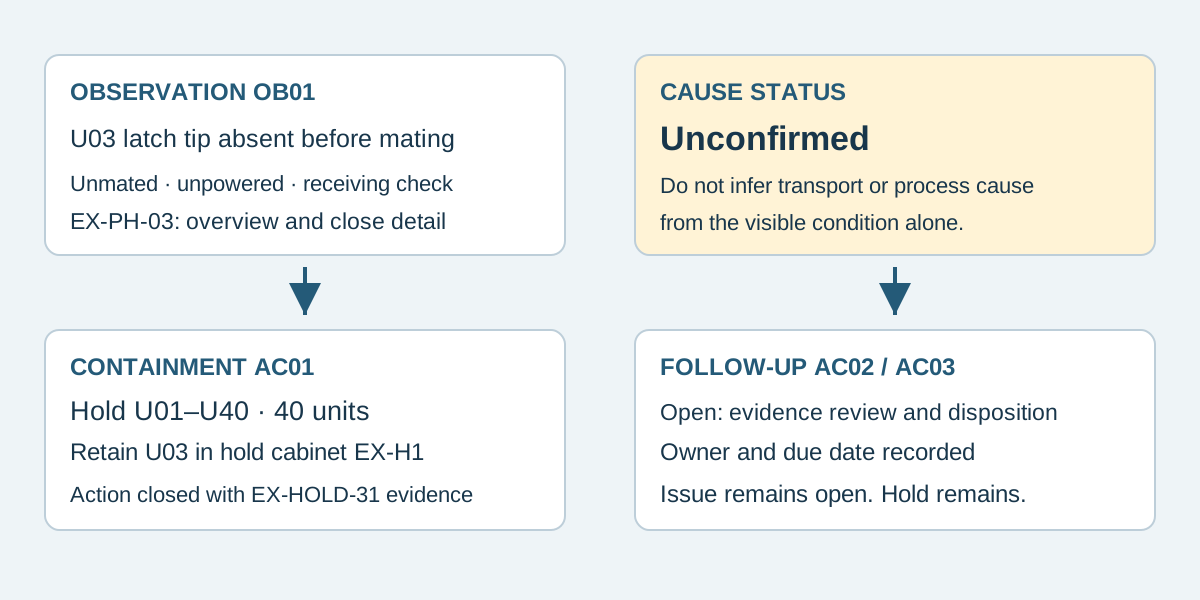
Conceptual illustration. Fictional examples are not approved product configurations, tooling instructions or inspection results.
Download the report and fictional example
Download the quality issue workbook. Use Blank record for a real issue and Example to see how an observation, containment action and unresolved disposition can coexist. Editable cells are amber; selected recording checks are white.
The incoming inspection template records the receipt and individual checks. This report follows an identified discrepancy through evidence gathering and communication. The testing guide explains test purposes; this resource records the actual method and conditions associated with a reported symptom.
Give the issue a stable identity
Create an issue ID and report revision. Enter the assembly reference, applicable drawing revision, receipt, lot and purchase order. Identify the reporter and a usable contact route. Include the first-observed date, stage and location, such as receiving, assembly installation or equipment operation.
Describe the configuration at that moment. Was the connector mated or unmated? Was the cable installed or loose? Was power applied? Which equipment-side part, fixture or test-program revision was involved? Record relevant handling or changes before discovery. Use a controlled attachment if the conditions do not fit one cell.
For an intermittent symptom, use the intermittent connection guide to record the sequence and observations from each attempt. Do not write always fails when the result occurred once. If the reported assembly has already been repaired or disassembled, state that directly and identify the changes. The current specimen may no longer preserve its original condition.
Separate an observation from an explanation
Write a condition that another reviewer can inspect or reproduce. Latch tip absent on U03 before mating is an observation. Shipping damage is a proposed explanation unless evidence establishes when and how it occurred. A test result can be real while the cause remains unknown.
Scroll sideways to read all columns.
| Record | Useful entry | Why it matters |
|---|---|---|
| Observed condition | U03 latch tip absent before mating | States what was seen |
| Requirement | EX-IP-31 A, intact latch | Identifies the comparison basis |
| Conditions | Incoming visual check, unmated and unpowered | Bounds the observation |
| Evidence | EX-PH-03 overview and detail | Lets others inspect the same feature |
| Cause status | Cause and timing unknown | Keeps investigation open |
| Current action | Hold identified stock pending review | States the immediate response |
If an electrical check reports an open connection, record the endpoint identities, fixture, procedure, limit and measured or reported result. Do not infer a broken conductor from a beep test alone. A connector interface, fixture contact or test definition may need examination before an explanation can be confirmed.
ASQ's description of 8D separates problem definition and containment from verification of causes and corrective actions. This workbook covers the initial evidence and action record. Agree any formal investigation format, responsibilities and deliverables separately.
Count the defined population, not the number of photos
The quantity section records scope units, examined units and observed affected units. The calculated not-examined quantity is scope minus examined. Its check flags missing inputs, non-whole or negative counts, examined quantities above scope and affected quantities above examined.
Use one assembly as the unit unless the report explicitly defines another basis. A single assembly with two observations is one affected unit, not two. Several photos of one latch are also one observation's evidence, not additional defective units. Do not add quantities across reports unless their populations are known to be disjoint.
In the example, scope = 40, examined = 5 and observed affected = 1. Therefore, 35 units have not been examined under the stated visual check. That arithmetic does not establish how many of those 35 have the same condition or a lot defect rate. It also does not determine how much stock should be held.
Follow the fictional EX-QI-31 report
EX-QI-31 concerns receipt EX-RC-31, lot EX-LOT-31, assembly EX-CA-31 revision B. All identities, document references and decisions are invented for learning. The example aligns with the incoming inspection workbook so readers can follow the same receiving event through both records.
Observation OB01 records the missing latch tip on U03. OB02 records visually intact latch tips on U01, U02, U04 and U05 under the same check. Those four units provide bounded comparison evidence; their appearance is not a statement that they satisfy every assembly requirement.
The quality lead places U01–U40 on hold. U03 remains untouched in hold cabinet EX-H1 with the same receiving identity. The retained specimen is included in held stock, not an extra unit. The record explicitly states that cause and timing are unknown.
Three actions are shown. AC01, identifying and segregating the 40 units, is closed with the hold-record reference. AC02 requests review of the photos and packed condition. AC03 requests an agreed examination or return decision before U03 is altered. AC02 and AC03 remain open with owners and due dates. Closing AC01 does not close the issue or release the material.
Build an evidence package that can be followed
Start with a view of the assembly identity or temporary receiving label. Add an overall view that shows which branch and connector are involved. Then include a clear detail view, keeping the orientation identifiable. For the example, show the latch area and U03 identity without inserting a tool that changes the feature.
Retain original files and use separately named annotated copies. Record the attachment IDs in the workbook. If a dimension matters, show the measurement method and scale, but preserve the underlying measured value and instrument reference as well. A photograph with a ruler may not establish a drawing tolerance by itself.
Preserve packaging, labels, suspect units and relevant comparison units according to the agreed investigation. Identify where each item is held and who has custody. If a specimen moves, record the handover, date and condition. Do not discard a failed part or send an untracked replacement sample while the issue is still under review.
Record containment and disposition separately
Containment describes the current measures used to prevent unintended use or mixing of identified material. Its scope may include more units than the observed symptom. Record that scope and authority rather than assuming the workbook's examined quantity defines it.
Disposition is the authorized next step for the material: continued hold, agreed examination, return, rework or release within a stated scope. Enter the decision and reference in the report header when it is made. Keep prior versions so a later decision does not erase the original observation.
Do not perform additional destructive tests, contact extraction or rework merely because the report has an empty result cell. Agree the purpose, specimen, method and authorization first. State which evidence must be preserved before any change.
Read the workbook's recording checks
Each observation row requires seven fields and a unique ID within the eight reserved rows. Action rows require an ID, type, description, owner, due date and recognized status. A Closed action requires an evidence reference; Open and In progress remain visibly open. These checks do not verify the evidence or approve closure.
There are six reserved action rows. If more are needed, extend the formulas and bounded duplicate-ID ranges, then test a duplicate and a closed action without evidence in the first added row. Keep unused rows entirely blank.
Common questions
Is this an 8D report?
No. It is an issue-evidence and follow-up record. A formal 8D investigation has additional work and verification requirements. Its availability and scope must be agreed for the project.
Can I report an issue before I know the cause?
Yes. State the observation, conditions and known scope, and mark cause unconfirmed. Waiting for an unsupported explanation can make the initial evidence less useful.
Does a closed action mean the stock is released?
No. An action can close when its specific task is documented while other actions and the material decision remain open. The named authority records the actual disposition.
Send the evidence with the decision you need
Contact Zeakka with the order and assembly references, issue report, original evidence and current stock status. Identify whether you need clarification, examination planning or a material-disposition proposal. Zeakka coordinates communication with the selected supplier for cable assemblies. Investigation methods, corrective work, formal reports and return arrangements are confirmed for the specific issue.
Share this article
Help others discover this content