
JST EH vs XH: Choosing Between Two 2.5 mm Connector Systems
Table of Contents
JST EH and XH share a 2.5 mm pitch, but pitch alone does not define their mating interface. If a PCB already carries a header, identify that exact header before choosing a cable. For a new design, compare the complete connection: its envelope, wire termination and access inside the enclosure.
Quick choice: investigate EH when the space above and beside the board is tight; investigate XH when the existing design already uses its housing and header system. Neither name is a shortcut to interchangeability or a higher usable current.
Original JST references at a glance
These are original JST catalog values checked on 7 October 2026. They are not specifications for Zeakka alternative components or finished cable assemblies.
Scroll sideways to read all columns.
| Item | EH | XH |
|---|---|---|
| Nominal pitch | 2.5 mm | 2.5 mm |
| Catalog current | 3 A AC/DC with AWG 22 | 3 A AC/DC with AWG 22 |
| Voltage | 250 V AC/DC | 250 V AC/DC |
| Series wire range | AWG 32–22 | AWG 30–22 |
| Series insulation outside diameter | 0.5–1.9 mm | 0.9–1.9 mm |
| Reference assembled height | 8.1 mm, top entry | 9.8 mm, illustrated top entry |
| Housing example | EHR-4 | XHP-4 |
The EH top-entry thickness is 3.8 mm. These dimensions describe particular catalog configurations; a side-entry arrangement needs its own drawing review. See the EH catalog, pages 1–3 and XH catalog, pages 1–4.
Same pitch is not a replacement approval
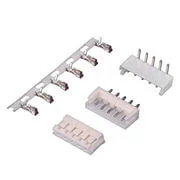
EH alternative catalog components. Shown for identification only; original catalog ratings do not rate these pictured alternatives. View EH alternatives.
Pitch measures the spacing between adjacent contacts. It does not describe the housing walls, keying, retention features, contact engagement or the direction in which wires leave a mated assembly. A connector that appears to enter a header may still be the wrong interface.
For an existing board, work from its bill of materials or an identified sample. Keep the mating header visible in the review: a photograph of a loose cable housing cannot establish everything about the board connection. Record the full part number, circuit count and orientation, then compare the actual drawings.
For a redesign, treat changing EH to XH, or XH to EH, as a connector-system change. Review both halves and the PCB footprint. Do not release a purchase order describing the new cable simply as “2.5 mm JST.” That description leaves the very distinction this comparison is intended to resolve open to interpretation.
Use the lower envelope only where it helps the assembly
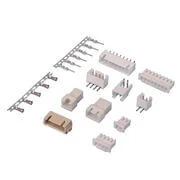
XH alternative catalog components. Shown for identification only; original catalog ratings do not rate these pictured alternatives. View XH alternatives.
The reference height difference makes EH worth investigating in a shallow enclosure. However, the enclosure must accommodate more than the plastic body. Model the wire exit, the first bend and the space required to insert or remove the plug.
For example, a lid may clear the mated connector but press against the wire bundle when closed. Moving to a lower housing does not resolve that problem if the wire still has to turn sharply in the same space. Reorienting the connection or moving the board entry can be a more effective design change.
Check access at the intended service stage. A connector that is accessible on an empty board may become difficult to reach after shields, neighboring cables and mounting brackets are installed. Review the assembly sequence with the enclosure drawing before choosing either series on height alone.
Match the contact to the wire, not just the series
EH's SEH-001T-P0.6 covers AWG 30–22 and 1.0–1.9 mm insulation OD. Its low-insertion-force SEH-003T-P0.6L covers AWG 32–28 and 0.5–1.1 mm OD. JST warns that the EH low-insertion-force contacts have reduced vibration resistance and different crimp heights. EH contact table and note, page 2.
For XH, SXH-002T-P0.6 covers AWG 30–26 and 0.9–1.3 mm OD; SXH-001T-P0.6 covers AWG 28–22 and 0.9–1.9 mm OD. XH contact table, page 3.
The practical consequence is that a series-wide wire range cannot be assigned to every terminal. Confirm conductor size and insulation diameter together. A wire can satisfy the AWG requirement while missing the insulation-barrel requirement. Changing the wire supplier or insulation construction therefore deserves a fit review even when the nominal gauge stays the same.
Equal headline current does not settle the choice
Do not read the two 3 A entries as a promise that any EH or XH cable will carry that current in your product. Define the current in each circuit, operating temperature and installation conditions, then assess the selected wire, termination and complete connection together.
A useful review separates the mechanical reason for changing the connector from the electrical reason. If the purpose is to reduce enclosure height, do not quietly increase circuit loading at the same time. Keeping those decisions explicit makes the resulting validation easier to interpret.
Which route fits your project?
- Existing EH header: identify the header and select its specified housing and contact combination. Do not substitute XH from pitch alone.
- Existing XH header: retain the approved interface unless a deliberate board and cable redesign is planned.
- New compact layout: compare complete mated envelopes and wire routing before choosing the smaller reference geometry.
- Alternative component project: assess the named alternative against the actual mating hardware and its own documentation.
Zeakka is a connector and cable-assembly sourcing business. Explore EH-series alternative connectors, XH-series alternative connectors or custom XH cable assemblies. Original JST parts are offered within finished cable assemblies, subject to the confirmed project scope. Specific EH cable-assembly configurations require project review.
For a component substitution, use the separate guide to verifying JST and Molex connector alternatives. For an EH/XH interface question, send the identified header and enclosure constraints so the review starts with the connection your product actually needs.
Related selection guides
Connector Current Ratings Explained: Wire Size, Circuit Loading and Temperature Rise · Connector Polarization vs Keying: Preventing the Wrong Connection
Share this article
Help others discover this content