
JST PH vs SH: Is a Smaller Connector Right for Your Harness?
Table of Contents
JST PH uses 2.00 mm pitch; JST SH uses 1.00 mm pitch. That difference makes SH worth considering when contact spacing is a constraint, but moving from PH to SH also changes the wire choices, mating interface and board assembly. The useful question is whether the complete connection still meets the product's requirements after it gets smaller.
Quick choice: keep the specified series for an existing PCB. For a new design, consider SH for a compact connection using fine wires and an SMT header. Consider PH when its wire options, electrical limits or through-hole header choices better match the assembly. They do not mate directly.
PH and SH: the decision table
The following values describe original JST catalog components. Alternative parts and finished harnesses require their own specification review.
| Selection point | JST PH | JST SH |
|---|---|---|
| Pitch | 2.00 mm | 1.00 mm |
| Catalog current | 2 A AC/DC with AWG 24 | 1 A AC/DC with AWG 28 |
| Catalog voltage | 100 V AC/DC | 50 V AC/DC |
| Temperature, including current-induced rise | −40 to +105 °C | −25 to +85 °C |
| Contact example | SPH-002T-P0.5S: AWG 30–24; insulation OD 0.8–1.5 mm | SSH-003T-P0.2-H: AWG 32–28; insulation OD 0.4–0.8 mm |
| Additional fine-wire contact | SPH-004T-P0.5S: AWG 32–28; OD 0.5–0.9 mm | Use the specified SH contact above |
| Board mounting shown | Through-hole and SMT | SMT |
| Entry directions shown | Top and side | Top and side |
Sources: JST PH catalog, pages 1–4; JST SH catalog, pages 1–3. Check the exact ordering reference and drawing before release.
Browse PH-series alternative connectors and SH-series alternative connectors when specifying alternative components.
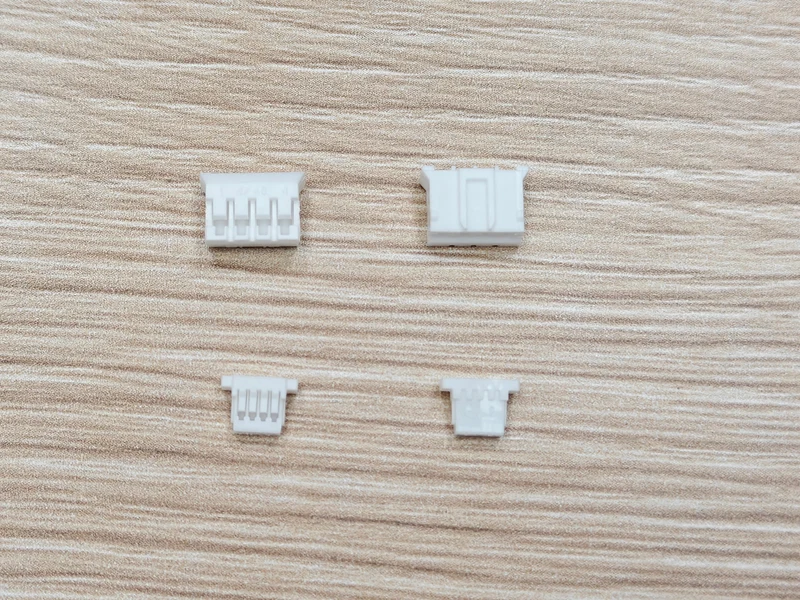
Alternative PH housings (top) and SH housings (bottom).
Start with the existing board, or start with the wire
For a replacement cable, the approved board header is the starting point. Request its full part number and mating drawing. Housing color, circuit count and a marketplace description such as “small JST plug” are insufficient. For a four-position sample, the first-to-last contact-center span is 6.00 mm at PH pitch and 3.00 mm at SH pitch. Use that as an identification screen, then confirm the interface geometry.
For a new design, start by defining the cable. A required AWG 24 conductor fits the listed PH contact range but is outside the listed SH contact range. Conversely, AWG 30 can appear in both systems, yet its insulation may fit one selected terminal and not the other. Wire gauge specifies conductor size; insulation outside diameter is a separate acceptance condition.
For example, an AWG 30 wire with 1.0 mm insulation OD falls within the listed ranges for PH's SPH-002T-P0.5S contact, but exceeds the SH contact's 0.8 mm maximum. A buyer cannot solve that mismatch by ordering a nominally equivalent “30 AWG SH cable.” The wire construction or connector decision needs review.
What the smaller pitch actually changes
Board space is only part of the envelope
SH halves the contact pitch relative to PH, not every dimension of the assembled connection. Compare the selected header, housing, solder pads, insertion travel and cable bend space in the enclosure. Side entry may move the cable path away from a cover but use space beside the board.
Check how the operator will grip the housing during assembly and service. A connector that fits the CAD model can still be awkward to disconnect beside a tall component. Provide a practical access path and keep cable routing from continuously pulling on the interface.
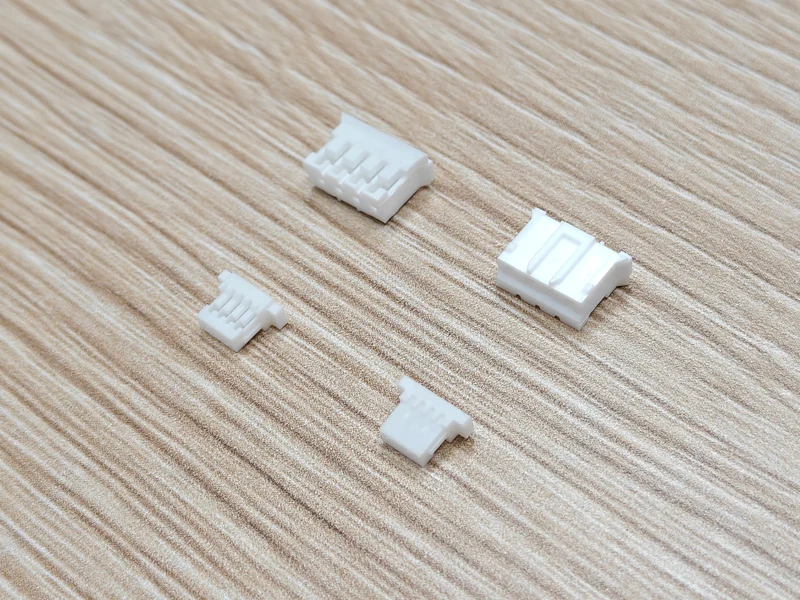
Angled view: alternative PH housings (upper row) and SH housings (lower row).
The electrical comparison follows the selected wire
The catalog current figures use different wire gauges. They do not mean every PH harness carries twice the current of every SH harness. Review actual load, duty cycle, ambient temperature, populated circuits and the chosen wire/contact combination. The stated temperature limits include heating caused by current; they are not ambient limits to which unlimited self-heating can be added.
This matters during miniaturization: retaining the same load while reducing wire size may create a cable or temperature constraint before the smaller housing solves the packaging problem.
Retention and assembly need separate checks
SH's housing lance retains the contact inside the housing. It should not be described as an external positive latch securing the housing to the header. Terminal retention and connector mating retention are different checks. PH and SH also require their own contacts and appropriate crimp processes; moving to SH is not a housing-only substitution.
If a defined external latch is central to the design, review GH versus SH as a separate interface decision. Do not infer vibration performance from a photograph or a generic series name.
Prepare an RFQ that survives the move to production
Supply the following together:
- Complete mating references, circuit count and connector orientation.
- Pin-to-pin mapping, with the drawing view identified and unused cavities marked.
- Wire gauge, insulation OD, wire specification, colors and finished length tolerance.
- Load, operating environment, routing constraints and service requirements.
- Quantity, prototype needs, acceptance requirements and original-or-alternative component preference.
Zeakka sells alternative connectors. For finished cable assemblies, original JST parts can be sourced subject to exact part numbers and availability, or unbranded alternatives can be reviewed for the project. Original JST components are not sold separately. Specific SH harness configurations need project review.
Use the custom PH cable assembly page for PH requirements, or send the mating reference and cable drawing for a PH/SH selection review.
Frequently asked questions
Can SH plug into a PH header?
No. Their pitches and mating interfaces differ. A cable with SH at one end and PH at the other connects two separately matched interfaces; it does not make the housings interchangeable.
Is SH always the better choice for a small product?
No. Check the complete envelope, cable requirements and assembly access. A smaller contact pitch is useful only if the resulting connection satisfies those constraints.
Can both series use AWG 28 wire?
The cited contact ranges include AWG 28, but insulation OD and the exact terminal still matter. An overlapping gauge does not make terminals interchangeable or establish equal current capability.
Does SH's housing lance lock the connector to the PCB header?
It retains the contact within the housing. Evaluate the housing-to-header mating arrangement separately; do not treat the term as a positive external latch claim.
What if the sample is neither PH nor SH?
Measure the pitch, record the mating features and compare the complete drawing. The common JST connector types guide provides a broader identification starting point.
Share this article
Help others discover this content