
TPA vs CPA: Two Different Connector Retention Checks
Table of Contents
TPA and CPA address different places in a connector assembly. Terminal position assurance, or TPA, concerns terminals inside the housing. Connector position assurance, or CPA, concerns the mated connector pair. If a drawing requests a “secondary lock,” clarify which function is required before selecting parts or comparing quotations.
A TPA does not secure the two connector halves simply because it retains their terminals. A CPA does not establish that every terminal is seated correctly. A design may need one, both or neither, depending on its specified connector system and application requirements.
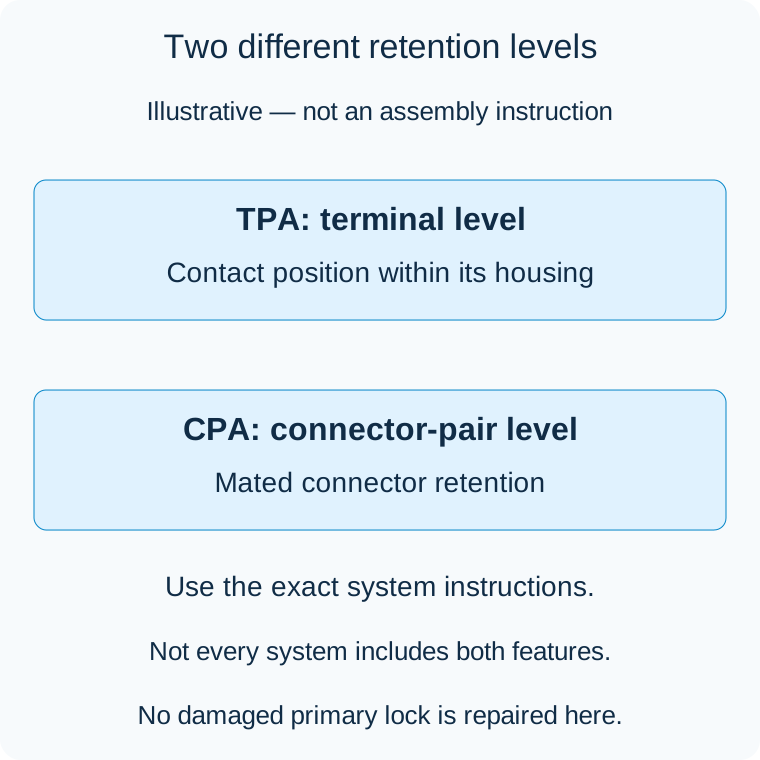
Illustrative functional distinction, not product geometry or an assembly instruction. The selected system determines the mechanism, operating sequence and final state.
Identify the part that must remain in position
Scroll sideways to read all columns.
| Review question | TPA focus | CPA focus |
|---|---|---|
| What is being retained? | Terminals within the housing | The connector halves in their mated state |
| What assembly step matters? | Correct terminal loading and the specified TPA engagement | Correct mating and the specified CPA engagement |
| What parts must be identified? | Housing, compatible terminals and applicable TPA feature or retainer | Both mating halves and the applicable CPA |
| What does it not establish? | Correct pinout, acceptable crimp quality or complete connector mating | Correct terminal seating, acceptable crimp quality or electrical performance |
| What should the drawing control? | Required configuration and completed terminal-retention state | Required configuration and completed connector-retention state |
Molex's connector contact retention guide separates terminal retention from connector retention. Its CPA example blocks operation of the primary mating latch; its terminal-retention discussion describes TPA arrangements. The exact mechanism still depends on the selected product.
TPA is a system feature, not a universal add-on
Do not assume that a housing accepts a TPA because another version in the same family does. The compatible terminal geometry and retention arrangement must be checked together. A family name on a quotation is insufficient when the approved design requires a particular TPA configuration.
Molex's Micro-Fit application specification 430450001-AS, revision A1 distinguishes standard housings from TPA housings. It lists 172952 dual-row and 171850 single-row TPA receptacle housing series, plus 203632 and 200875 TPA plug housing series. It also identifies 43031-5xxx male terminals specifically for TPA plug housings. This is a documented variant distinction, not a claim that every Micro-Fit assembly includes TPA.
TPA is not always a loose accessory. The Micro-Fit product overview describes both an additional piece and a secondary locking mechanism attached to the housing. For a purchasing review, therefore, ask whether the required feature is integral, attached or separately supplied, and how its completed state will be identified.
CPA requires the correct mating arrangement
A CPA should be evaluated with the mating housings and primary latch, not selected from its appearance. Check that it is intended for the exact connector configuration and that the installed equipment leaves room to operate it. A nearby enclosure wall can make a specified release sequence impractical even when the connector itself fits.
The Ultra-Fit application specification 1723230003, revision C1 identifies TPA series 172264 and CPA series 217185 within its scope. Pages 6–7 show their different locations and the CPA assembly/disassembly sequence. Those instructions belong to the documented Ultra-Fit arrangement; they are not a generic procedure for other Molex or JST products.
For a pre-installed assurance device, distinguish its shipping or pre-lock position from its final position using the specific manufacturer's instructions. Do not assume that every system has the same two-stage mechanism, sequence or inspection cue. A visible assurance component is not, by itself, evidence that the assembly has reached its required final state.
Secondary retention does not repair an assembly defect
The Ultra-Fit specification requires terminals to be fully seated and locked during insertion. It also calls for replacement when the connector latch or CPA is damaged. Adding or forcing an assurance device is not a repair for an incorrectly assembled connector or a damaged primary latch.
For incoming inspection, separate three questions: are the specified parts present, are they assembled in the required state, and is the electrical assembly correct? A photograph can help identify components and visible positions, but it cannot establish crimp quality or the complete electrical connection schedule.
Similarly, do not use an assurance feature as a substitute for cable support. The cable route, attachment points and service handling still need their own review. If an assembly fails while being pulled or bent, first identify where the failure occurs; “add a lock” is too broad a corrective action.
Make the requirement visible in the order
Specify the manufacturer and full housing, terminal and accessory part numbers, together with the applicable drawing revision. State whether a separately supplied TPA or CPA must be included and what state is required at delivery. A cable shipped unmated may have a different completion stage from a pair supplied already connected.
Assign responsibility for any final operation performed during equipment assembly. For example, if the customer mates the harness after installation, the work instruction should identify who completes and checks the CPA operation. This avoids a gap between the cable supplier's delivery inspection and the equipment assembler's acceptance check.
Use a clear detail on the cable assembly drawing rather than relying on a note that says only “with safety lock.” If a replacement changes the assurance arrangement, document it through the engineering change process.
Review alternatives against their own evidence
An alternative housing does not automatically inherit the original connector's TPA or CPA function. Request its own compatible-part list, assembly instructions and relevant retention evidence. A similar-looking retainer or a successful trial mating does not establish equivalent operation. The connector alternative verification guide provides a broader review framework.
Zeakka is a cable assembly sourcing partner. Original-brand connectors are offered in finished cable assemblies, not as standalone connector sales. Send the approved parts list, drawing and retention requirements to review the requested assembly and any proposed alternative before quotation.
Related selection guides
Connector Polarization vs Keying: Preventing the Wrong Connection · Connector Mating Cycles Explained: Choosing for Assembly and Maintenance
Share this article
Help others discover this content