
Cable Assembly First Article Inspection: Linking Drawing Items to Results
Table of Contents
A cable assembly first article inspection report should let a reviewer move from a requirement to its evidence without guessing. Numbered drawing characteristics, BOM items and inspection notes need matching report entries, including entries that remain incomplete.
Agree the scope and format before the first article is built. A photograph labeled “sample approved” does not tell the reviewer which dimensions, materials or electrical requirements were checked. A completed inspection report also does not by itself authorize production release.
Connect each drawing characteristic to its own evidence
Fictional EX-FA-35 illustration with C01 length, C02 orientation, C03 contact identity and C04 connection requirements. The report records two conforming observations and two missing-evidence items; it is not a production release.
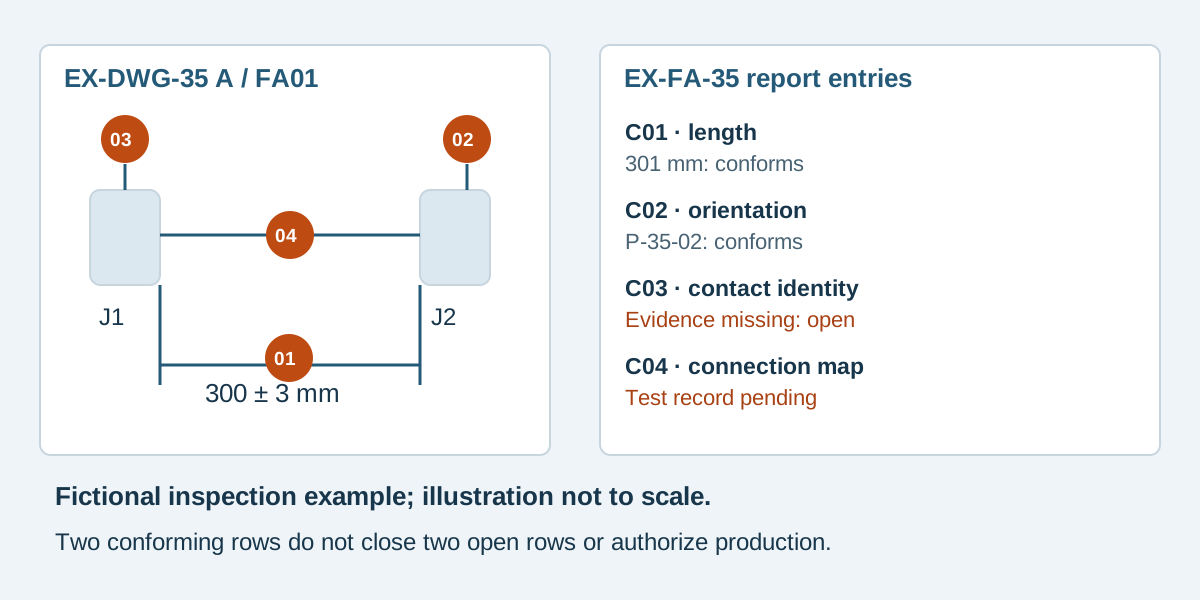
Conceptual illustration. Fictional examples are not approved product configurations, tooling instructions or inspection results.
Establish the inspection baseline
Record the assembly number, drawing and BOM revisions, article identity and applicable inspection requirements. Include referenced specifications or supplementary documents that contain acceptance criteria. When a requirement is located in a separate connection list, the report should identify that list and its revision rather than paraphrase a potentially outdated map.
Confirm what the term “first article” means for the order. A project may request a customer-specific report, while another contract may require a named industry standard and its prescribed process. The IAQG description of 9102 identifies a standardized FAI process and documentation framework developed for aviation, space and defense. The example below is a general project worksheet, not a 9102 form, certification or claim of compliance.
If a contractual standard applies, specify its required revision and customer instructions. Do not label a convenient spreadsheet “AS9102 compliant” merely because it includes measurements and a signature.
Give each requirement a stable reference
Add characteristic identifiers to the controlled inspection copy of the drawing or its agreed companion index. Keep each identifier unambiguous. A numbered length, a connector orientation requirement and a specified material identity need distinguishable entries, even when they concern the same end of the cable.
For dimensions, retain the nominal value, tolerance, units, datums and measurement condition. The length and tolerance guide explains why a connector-face length differs from a cut-wire length. The report must measure the requirement actually drawn, not a more convenient distance.
For BOM characteristics, record the required part and the evidence used to establish the fitted identity. A housing photograph may support appearance and orientation but cannot always establish contact material or plating. Use a record suited to the characteristic and identify any limitation.
Plan checks that will become inaccessible. A joint covered by a sleeve or an internal termination may need agreed in-process evidence. An after-assembly photograph should not be used to imply that a hidden feature was directly inspected.
A fictional drawing-to-report example
EX-FA-35 is an invented article, unit FA01, drawing EX-DWG-35 revision A and BOM EX-BOM-35 revision A. Its fictional inspection plan IP-35 A defines the measurement arrangement and methods. These dimensions and decisions are examples only, not standard tolerances for cable assemblies.
Scroll sideways to read all columns.
| ID and requirement | Recorded evidence for FA01 | Status |
|---|---|---|
| C01: J1 face to J2 face, 300 ± 3 mm, in the specified laid-flat condition | 301 mm; result sheet M-35, instrument identification and inspection date retained | Conforms to this dimensional requirement |
| C02: J2 latch orientation per view B | Photograph P-35-02 shows the required orientation against view B | Conforms to this visual requirement |
| C03: contact identity per BOM item 04 | Housing photo supplied; contact identity record not supplied | Open: obtain traceable component evidence |
| C04: connections and isolated positions per map CM-35 A | Test record not yet supplied | Not verified: evidence pending |
The C01 permitted range is 297–303 mm, so the recorded 301 mm falls within that fictional requirement. The inspection plan must still define a suitable method, instrument capability and decision rule. A numeric result should not be detached from those conditions.
C02 does not establish C03. The visible housing orientation cannot verify a hidden contact identity. C04 should not be marked PASS because the cable looks correctly wired or because someone remembers a tester indication. Attach the agreed record to the correct article.
This report remains incomplete. Two conforming rows do not cancel two open rows, and neither a purchase deadline nor an attractive sample photograph changes their status.
Record actual results and usable evidence
A dimensional entry should contain the measured result where required, not only “OK.” An attribute requirement may use a conforming/nonconforming result with an identified method and supporting evidence. Material or component identity may require supplier records tied to the article or its build lot.
Keep instrument or equipment identification, method reference, inspection date and responsible person at the level needed by the agreed procedure. If a result comes from another report, give its identifier and relevant page or characteristic. “See attachment” is weak when several unnumbered attachments exist.
A test report for a different revision or an unidentified unit does not automatically establish conformity for the article under review. Request clarification and retain the mismatch visibly until the responsible reviewer resolves it.
Handle missing, nonconforming and inapplicable items separately
Use separate states for not inspected, evidence pending, nonconforming and not applicable. They answer different questions. A missing measurement is not a measured failure; a measured failure is not simply missing paperwork.
For a nonconforming result, retain the original value and requirement, identify the issue record and state the authorized disposition. Do not alter the tolerance to fit the result. For rework, identify what changed and which checks were repeated. Preserve the earlier record so the final result has an understandable history.
An inapplicable entry needs a rationale tied to the actual configuration. Avoid a blanket N/A across a connector family when the specific assembly contains only one variant. The agreed scope should make clear which features and records belong to this article.
Keep inspection completion separate from release
The sample approval checklist covers the customer's configuration, application-validation and production-release decision. Use the first article report as evidence within that process. It does not replace equipment fit checks or other separately required validation.
When the design, material, source or process changes, review which characteristics and evidence may be affected under the applicable requirements. Do not assume every change always needs a full repeat, or that an old report always remains sufficient. Record the agreed review scope and retain the changed baseline.
Frequently asked questions
Is a first article report the same as sample approval?
No. The report links requirements to inspection evidence. Sample approval also records the customer's decision for the stated configuration and application scope.
Can every characteristic be marked PASS from one photograph?
Only evidence suited to each characteristic can support its result. Hidden identities, dimensions and electrical checks often need different methods or records.
How many articles must be inspected?
Agree the quantity, selection and scope in the applicable contract or inspection plan. There is no universal number specified by this guide.
Agree the report before the pilot build
For low-volume cable assemblies, send the controlled drawing, BOM and required report format before sample manufacture. Identify required evidence for hidden or destructive checks early. Zeakka coordinates the supplier's response as a trading partner; contact Zeakka to confirm the proposed inspection scope and any unresolved records.
Share this article
Help others discover this content