
Cable Assembly Incoming Inspection Record Template
Table of Contents
A receiving record should let someone reconstruct what arrived, which units were examined, what was observed and who authorized the next step. This editable cable assembly incoming inspection template keeps those facts in one receipt record, with references to the drawings, photos and measurements that support it.
Use the blank sheet for a real receipt and the fictional example to see how a discrepancy remains visible even when the quantities reconcile. The template records an agreed inspection plan. It does not choose a sampling scheme or release material automatically.
Keep receipt quantity, inspection scope and disposition distinct
Fictional EX-RC-31. Five units receive the stated visual check. One observation leads to a recorded hold of all 40 units, without classifying every unit as defective.
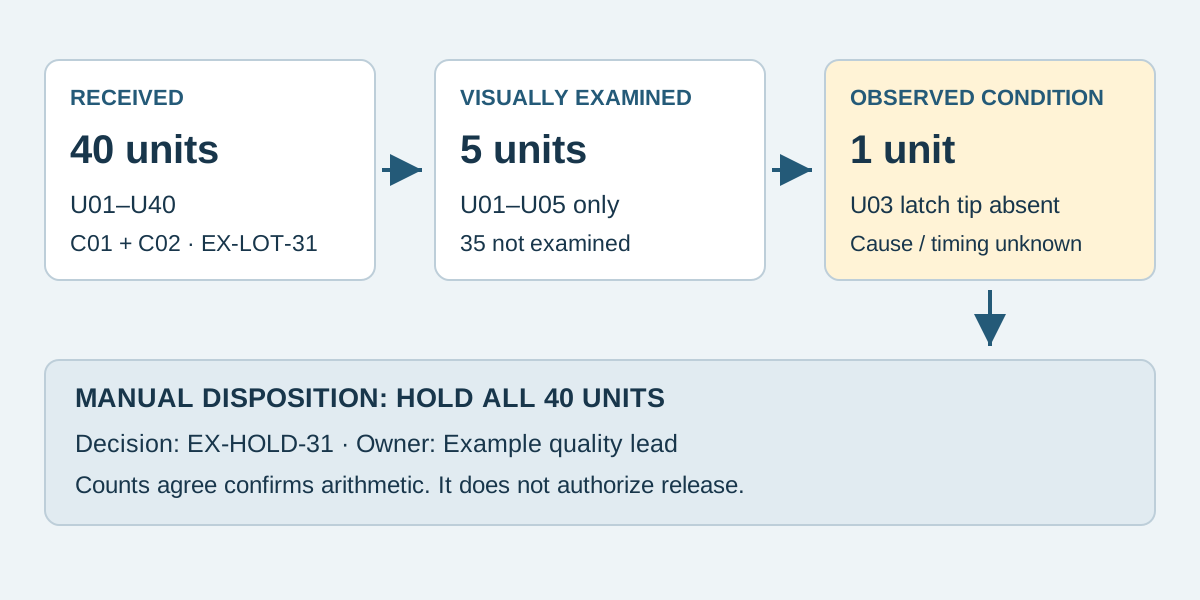
Conceptual illustration. Fictional examples are not approved product configurations, tooling instructions or inspection results.
Download the blank record and completed example
Download the incoming inspection workbook. The file contains two sheets: Blank record and Example. Amber cells are editable. White check columns flag selected missing fields, duplicate check IDs and inconsistent quantities.
The packaging guide covers protection, labeling and the receiving workflow. This resource supplies the record used after delivery. The sample approval checklist addresses a different decision: approving a defined sample configuration for a stated production scope. Receiving one production shipment does not repeat or replace that approval.
Identify the receipt before recording results
Enter the receipt and supplier lot references, assembly number and revision, purchase order, packing list, drawing and BOM revisions. Record the cartons and unit identifiers actually available. If units are not individually serialized, assign temporary receiving IDs and preserve the mapping to their pack and lot. Do not present those temporary IDs as supplier serial numbers.
Name the inspection plan and revision. Add the inspector, review authority, inspection date and current manual disposition. A statement such as hold pending drawing confirmation is more useful than a blank decision field that could be mistaken for release. Keep the open issue, responsible person and next-action date alongside it.
Separate receipts when their assembly revisions or traceability scopes differ. If a delivery mixes lots, use distinct records or a clearly controlled attachment showing which units belong to each lot. A carton number alone may not establish manufacturing identity.
Define the scope separately for every check
The inspection table has eight reserved rows. Add only checks required by the actual plan and identify the evidence for each one.
Scroll sideways to read all columns.
| Field | What to record | Example convention |
|---|---|---|
| Check ID | A stable identifier without descriptive text | IC03 |
| Item and requirement reference | Check name, controlling document, revision and detail | Latch appearance: EX-IP-31 A, intact latch |
| Scope and unit IDs | Exactly which parts or documents were examined | U01–U05 only |
| Method and instrument | Procedure, viewing condition and instrument identity where applicable | Visual, unmated connector |
| Actual result | Observation or measurement, including units | U03 latch tip missing |
| Evidence reference | File, photo, measurement log or test-record ID | EX-PH-03 overview and detail |
| Inspector judgment | Comparison with the stated requirement and unresolved question | Observed discrepancy; hold lot |
A quantity count can cover the complete receipt while a dimensional check covers selected units. A document check examines the supplied record and its identity; it does not mean the receiving inspector repeated the supplier's electrical test. State those scopes explicitly.
NIST's introduction to acceptance sampling describes using sample information to make a lot-disposition decision under a sampling approach. The workbook deliberately provides no default AQL, sample size or acceptance number. Agree the selection method, coverage, acceptance rules and response to a discrepancy before using the record for lot decisions.
Follow fictional receipt EX-RC-31
The example receives 40 units of EX-CA-31 revision B in cartons C01 and C02, with 20 units per carton. Temporary IDs U01–U40 identify the received units. All EX references, people and requirements in this example are invented for teaching. They are not real production records or standard Zeakka limits.
The inspector compares pack labels against the order and drawing, counts all 40 units, and examines U01–U05 visually. U03 has a missing latch tip before mating. The other four examined units have visually intact latch tips. This observation does not establish when the damage occurred or the condition of the other 35 units.
A separate length row records 298, 300, 301, 299 and 300 mm for U01–U05 against the fictional drawing requirement of 300 ± 3 mm. The datum method and ruler identity are referenced. These numbers illustrate recording a unit-bearing result; neither the tolerance nor the five-unit coverage is a recommendation for another assembly.
The document row records that the referenced test record was supplied and matched to the stated lot. That is a document-identity check only. Any review of its test limits, coverage or results needs its own recorded scope.
The example quality lead places all 40 units on hold pending review under EX-HOLD-31. One observed discrepancy and 40 held units answer different questions. Holding the receipt does not label every unit defective.
Reconcile quantities without counting a unit twice
The quantity section compares received units with five mutually exclusive allocations: held, released, returned, scrapped and pending allocation. Enter zero for a category that has been checked and has no units; leave an unknown value unresolved rather than inventing a zero.
In the example, received = 40, held = 40 and every other allocation = 0. The calculated accounted quantity is 40 and the check reads Counts agree. That message confirms arithmetic only. The manual disposition remains Hold all 40 units.
A retained specimen is still part of its applicable allocation. U03 remains within the 40 held units, so it must not be added as a forty-first unit. When material moves from held to returned, reduce held and increase returned by the same number, recording the supporting disposition separately. Do not count the same part in both categories.
Keep usable photos and measurement evidence
Capture the carton identity and condition, the complete assembly with its receiving ID, and a close view of the discrepancy. For a connector, retain enough context to identify the mating face, latch or cable exit. Include a scale when size matters, without obscuring the feature. Keep the original files and use annotations on copies.
Name files so the receiving ID and observation can be recovered. EX-PH-03 should resolve to U03's actual images, not an unrelated example connector. Preserve the packaging and affected part as the agreed investigation requires. Do not alter a latch, remove a contact or perform a destructive test simply to complete a photo record.
When a table cell summarizes several measurements, attach the full unit-by-unit log, instrument identity and method reference. For electrical observations, use the agreed procedure and suitable fixture. The testing guide explains why a continuity result, short-circuit check and mechanical test describe different properties.
Use the checks and extend the file carefully
A used check row must contain all seven input fields. Its ID must be unique within rows 13–20. The quantity section requires six numeric, nonnegative whole-unit counts and checks whether the allocations total the receipt. It does not interpret the entered requirement, verify photos or compare a text measurement with a tolerance.
Keep unused rows completely blank. To add more checks, copy the formulas and update the duplicate-ID range at both ends. Test the first added row with a duplicated ID and a missing evidence reference. Copying text below the reserved area alone does not extend validation.
Common questions
Can the file decide whether a shipment passes?
No. The named authority applies the agreed inspection and disposition rules. A complete row or matching total can coexist with an unresolved defect, missing approval or incorrect requirement.
Can I reuse the example sample size and tolerance?
No. Both are fictional. Enter the approved coverage, selection method, dimensional definitions and criteria for the actual assembly.
What if a receipt has no individual serial numbers?
Assign temporary receiving IDs and document their relationship to cartons and supplier lot information. Preserve that relationship through photos, retained samples and any return.
Share the receipt with its open issue
Contact Zeakka with the assembly and order reference, completed receiving record, relevant photos and the decision or information needed. For an observed discrepancy, use the quality issue report to organize the follow-up evidence. Zeakka coordinates supplier communication for cable assemblies; examination, corrective work, returns and additional records are confirmed for the specific project.
Share this article
Help others discover this content