
Cable Assembly BOM Template
Table of Contents
A cable assembly bill of materials lists what belongs in the finished assembly, how much is needed and which document defines each item. It also gives the supplier a place to distinguish customer-specified parts from proposed alternatives and board-side references that are outside the shipment.
Download the editable BOM workbook. It contains a blank BOM and a filled fictional example. The amber cells are editable inputs. Component quantities calculate from the order quantity at the top of each sheet.
Link the BOM to one finished assembly
Separate supplied components, quantities, units and reference-only mating parts.
Conceptual illustration. It does not depict an approved product configuration or test result.
Start with one assembly and one revision
Give the finished assembly its own identifier before listing components. Enter the drawing reference, drawing revision, BOM revision and requested number of assemblies. A quotation for 100 finished harnesses is not a request for 100 of every component: each harness may contain two housings, four contacts and several wire lengths.
Use a separate BOM for a different finished configuration, or agree an explicit variant structure. A longer wire, another cavity population or a different board interface can change more than the description. Keep the connection list and drawing revision associated with the same assembly identifier.
The BOM complements the RFQ preparation checklist. It does not replace the drawing's length datums, cavity assignments or acceptance requirements.
Fill the component fields
Scroll sideways to read all columns.
| Field | Enter | Common issue to resolve |
|---|---|---|
| Item role | Assembly component or reference only | A mating header is listed even though the customer installs it on the PCB |
| Reference | Exact part reference or a clearly labeled unresolved description | A family name is used where a specific housing, terminal or wire is required |
| Quantity per assembly | Amount used in one finished assembly | Order quantity is entered again as the per-assembly quantity |
| Unit | Pieces, metres or sets | A 250 mm wire is recorded as 250 metres |
| Supply owner | Customer, supplier or responsibility to confirm | Both parties assume the other will provide the part |
| Identity basis | Exact specified part, alternative pending review or unknown | An unapproved candidate is presented as a released substitute |
| Document and revision | Drawing or specification defining the listed item | A revised drawing is paired with an old reference |
| Notes | Location, exclusions, open questions and approval conditions | Requirements are buried in an email that is not part of the review package |
Keep an original manufacturer's full reference when it is specified. Preserve meaningful suffixes and link the applicable document. Product documentation has different roles: for example, Molex's KK Plus application specification directs readers to sales drawings for dimensions, materials, plating and markings. Use that distinction to obtain the correct definition for a proposed item rather than treating one family brochure as the entire part specification. Molex application specification
Follow the fictional example
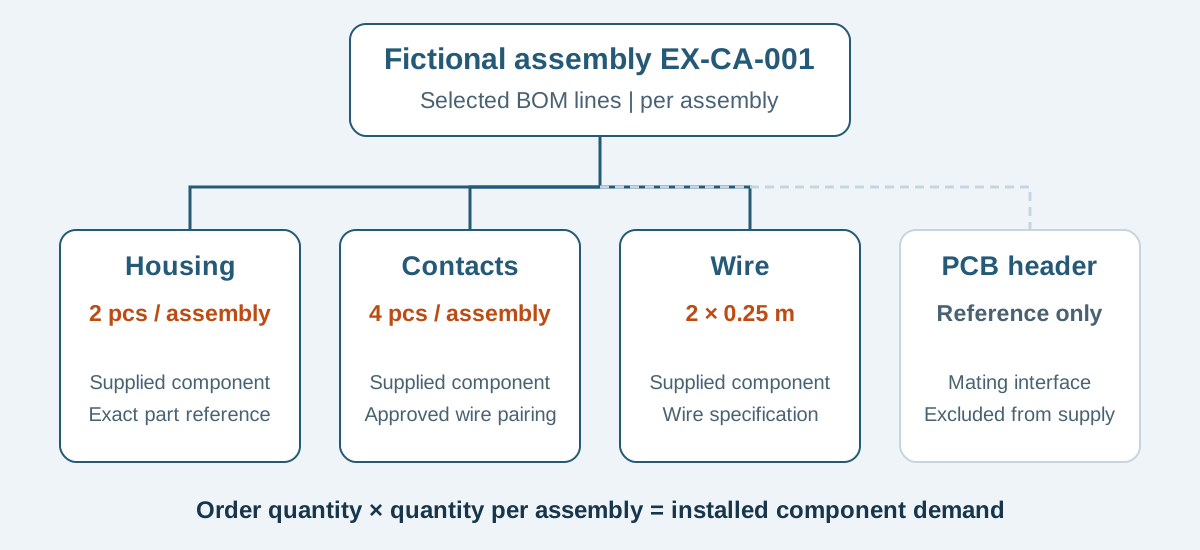
The workbook's EX-CA-001 example describes a two-conductor harness with a housing at each end. All EX references are teaching labels, not orderable components or an approved mating combination. The example order is 100 finished assemblies.
Scroll sideways to read all columns.
| Item | Quantity in one assembly | Calculated total for 100 assemblies |
|---|---|---|
| EX-HSG-2P housing | 2 pieces | 200 pieces |
| EX-CONTACT contact | 4 pieces | 400 pieces |
| EX-WIRE-RED | 0.25 m | 25 m |
| EX-WIRE-BLACK | 0.25 m | 25 m |
| EX-LABEL | 1 piece | 100 pieces |
| EX-BOARD-HEADER | Reference only | Excluded from shipment quantity |
The two wire rows describe illustrative cut lengths. They do not define the finished length between connector reference surfaces. That relationship belongs on the assembly drawing, with its preparation requirements.
The Total qty column multiplies the component quantity per assembly by the order quantity. It leaves a row blank when the component reference or required numeric input is missing. Reference-only rows have no procurement total. A blank total therefore needs review; it is not confirmation that no material is required.
Keep purchasing allowances separate
The calculated quantities are net component usage. The file adds no spare contacts, cutting losses, scrap allowance, supplier MOQ or reel rounding. Agree those commercial inputs separately and record who owns any excess material.
Do not add metres and pieces into a grand total. Review each component in its own unit. If the order changes from 100 to 120 assemblies, the example housing requirement becomes 240 pieces and the red-wire requirement becomes 30 metres. That arithmetic does not determine how much material a supplier must purchase or how it prices the finished assembly.
The blank sheet reserves 16 component lines. When extending it, copy the quantity formula and relevant validation to the added lines. Maintain a stable line identifier so that a question about a contact or wire can be tied back to the same item after sorting.
Record alternatives without approving them accidentally
Use “Alternative pending review” when a supplier proposes another component. Retain the required reference and candidate drawing in the review package. Check the housing, contact, conductor size, insulation diameter and mating part as a combination before approving a substitution.
A matching pitch is only one dimension. The alternative connector review explains the inputs for assessing a candidate. Original-part ratings and approvals do not automatically transfer to an unbranded alternative.
Send a complete review package
Send the BOM with the current drawing, connection list, requested quantity and unresolved questions. Include the board-side mating reference even when it is outside the supply scope, and label that exclusion clearly. For finished-length and cavity-view requirements, use the drawing preparation guide.
For custom discrete-wire cable assemblies, Zeakka coordinates sourcing and supplier review. Exact component selection and available supply are reviewed by project. Original branded components are considered within finished assemblies; original loose parts are not sold separately.
Common questions
Is a BOM sufficient for production?
It identifies components and quantities. Production also needs an agreed connection map, dimensional drawing, preparation details and acceptance requirements. Resolve missing information before treating the package as released.
Can I leave the contact reference unknown?
Yes, for an initial sourcing enquiry. Mark it unknown and provide the housing, mating part and wire information. A candidate must be reviewed before the assembly definition is approved.
Does the template calculate cable pricing?
No. It calculates net material quantities for the listed assembly count. Component purchasing packs, labour, tooling, inspection, logistics and commercial terms require a separate quotation.
Share this article
Help others discover this content