
Cable Bend Radius: Fixed Routing vs Repeated Motion
Table of Contents
A cable that fits inside an enclosure may still be forced into a bend its construction was not designed to accept. For a custom cable assembly, identify the actual cable, how it moves and where the bend occurs before choosing a routing dimension. A soft jacket or a flexible-looking boot is not evidence of repeated-flex life.
This guide explains what to put in a drawing or RFQ. The strain-relief guide covers where mechanical loads are carried; bend-radius review covers the geometry and motion of the cable between those supports. Both decisions must work in the installed assembly.
Identify the movement before reading the radius
Distinguish a cable formed during installation and then held in place from a cable that moves during servicing, and from a cable that bends during normal machine operation. A hinged cover opened occasionally is a different use from a cable travelling with a mechanism on every operating cycle.
Scroll sideways to read all columns.
| Installation | Information to provide | What a radius statement alone cannot establish |
|---|---|---|
| Fixed route | Installed path, assembly access and any movement before fastening | Whether installation introduces an unacceptable tight turn or tension |
| Occasional movement | Service positions, bend location and expected handling | Suitability for continuous machine motion |
| Repeated bending | Motion path, travel, speed, cycle requirement and environment | Service life of the complete terminated assembly |
| Bending with twisting | Rotation, direction changes and free length as well as the bend | Suitability for torsion or combined loading |
Cable suppliers may use different terms for these conditions. LAPP's application guidance distinguishes fixed installation, occasional flexing and continuously flexible use. Read the definition associated with the selected cable rather than transferring the smallest figure in a table to every application.
Use the specification for the exact cable
Record the manufacturer, full cable reference, construction and document revision. Check whether the published limit is a dimension or a multiple of cable diameter, and which installation condition it describes. If the proposed material is an unbranded alternative, request its own documented limit and applicable conditions; a visually similar branded cable's datasheet is not its evidence.
Diameter is also a defined input. An overall jacket diameter differs from the diameter of a single insulated conductor. Sleeving, shielding and a formed cable end can change the installed envelope. Do not substitute the width of a loose bundle for the diameter used by a round cable's specification. For a flat or non-round construction, ask which bending direction and dimension the supplier's guidance covers.
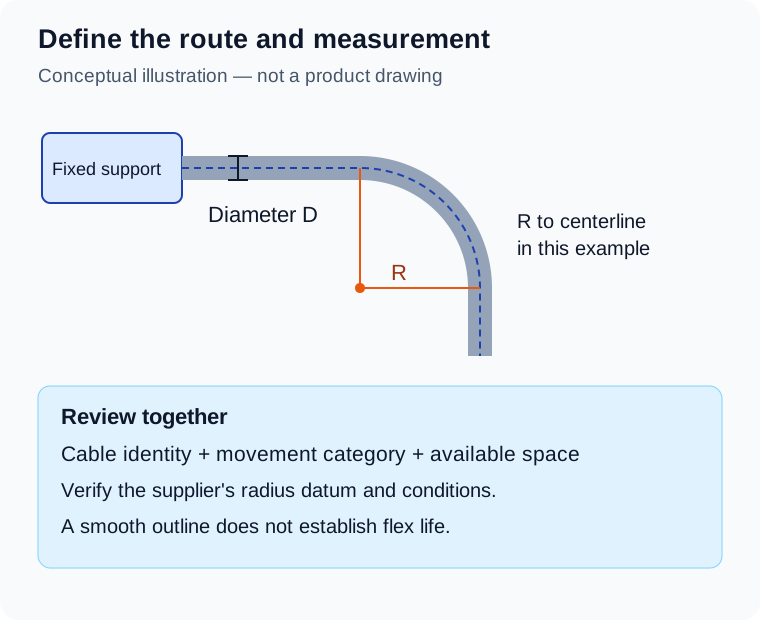
Conceptual illustration, not a product drawing. R is shown to the cable centerline in this example; verify the measurement convention in the selected cable and carrier documents.
When a supplier expresses a limit as R = k × D, identify what its symbols mean before applying the calculation. A correct multiplication cannot fix the wrong cable identity, movement category or measurement datum. Ask for clarification if the document does not define those inputs.
Put the radius on the installed route
Draw the connector exit, the first support, the required turn and the available space. Mark where the radius is measured and show the extreme positions if anything moves. A route drawn only in its relaxed central position can hide a tighter curve when a lid closes or a mechanism reaches the end of travel.
Check the path used during assembly too. Threading a terminated lead through a small opening can impose a different bend from the final installation. If a connector or boot cannot pass through the opening, changing the assembly sequence may be needed; bending the cable more sharply does not resolve the connector envelope.
Keep the cable clear of latch operation and service access. For board connections, the vertical versus right-angle header guide helps establish the mating direction and clearance. Header orientation does not set an allowable bend radius for the attached cable.
Review cable carriers as a system
A carrier's nominal radius describes its own geometry. The cable inside still needs the intended room and a suitable route. Multiple cables or hoses can have different requirements; the carrier must be selected against the contents and operating conditions rather than the most convenient catalog size.
Igus's bend-radius explanation separates fixed, freely moving and carrier conditions for its cables. Its installation guidance also discusses room for movement and application-specific anchoring. These sources demonstrate why installation details matter; they do not qualify a Zeakka assembly or establish a universal carrier-spacing rule.
For a proposed moving assembly, give the supplier the carrier reference if one exists, cable arrangement, travel and support positions. Identify other cables sharing the route. Do not claim a service-life result simply because one individual cable has a supplier test report: the termination, restraints and installed motion must also be reviewed.
Do not use a boot to conceal a routing conflict
An overmolded transition or protective sleeve can affect the way bending develops at the connector exit. It also takes space and can move the flexible section farther from the connector. Review its shape and material together with the actual cable route.
A fixed anchor can remove pulling load from a termination while leaving a sharp bend just beside the anchor. Conversely, a smooth-looking bend may still put the cable under tension. Check retention and bending separately. Avoid adding a universal boot length, bend multiple or clamp spacing to the drawing without a basis in the selected construction.
Agree the evidence before approving a sample
For a fixed route, review the installed assembly and confirm that the specified path can be achieved without violating the selected cable's requirements. Include assembly and service positions in that review.
For repeated motion, define the configuration, test motion, cycle requirement, environment and acceptance criteria with the responsible engineer and supplier. Identify how mechanical damage and electrical function will be assessed. Record what the report actually covers, including cable identity and drawing revision. These are project-review inputs, not included Zeakka test services or a standard procedure offered for every order.
The cable assembly testing guide explains why routine continuity and short-circuit checks do not establish repeated-flex life. Keep any motion approval tied to the identified sample and conditions in the sample approval record.
Frequently asked questions
Is there one safe bend-radius multiple for all cables?
No. Use the exact construction's specification for the intended installation and motion. If the supplier cannot provide an applicable requirement, leave the routing decision unresolved rather than presenting a generic multiple as a validated limit.
Can I use the fixed-installation limit for a moving cable?
Do not assume that it applies. Confirm the relevant motion category, including occasional movement, continuous bending and torsion where applicable. A fixed-route dimension does not establish fatigue life.
Does a flexible wire make the finished harness continuous-flex capable?
No. Review the full cable construction, terminations, supports and motion. A description of one constituent wire does not qualify the completed harness for the required repeated movement.
Send the route with the sourcing request
Provide the cable reference or proposed requirements, cross-section or diameter information, installed sketch, motion positions and any supplier radius document already selected. Add the required service life or validation objective where motion matters. The RFQ checklist covers the remaining quantities and electrical information.
Zeakka is a trading and sourcing partner. Send your route sketch and open questions so cable selection, supplier evidence and sample-review scope can be clarified together. Availability of a particular moving-cable construction and any validation service must be confirmed for the project.
Share this article
Help others discover this content