
Molex Mini-Fit Jr. vs Mega-Fit: Choosing a Power Cable Interface
Table of Contents
Which should you choose?
Mini-Fit Jr. is the starting point when an existing design already uses its 4.20 mm interface and the verified connector configuration meets the load. Mega-Fit uses a 5.70 mm interface and is worth evaluating when the power path needs more current capacity. Moving between them changes the mating connection; it is not a cable-only upgrade.
For a new design, compare the complete power path: connector pair, terminals, wire, board connection and enclosure. For an existing product, identify the installed interface before choosing a replacement cable. Neither a familiar housing shape nor a larger conductor establishes compatibility.
The differences that affect a cable assembly
Scroll sideways to read all columns.
| Selection point | Mini-Fit Jr. | Mega-Fit |
|---|---|---|
| Mating pitch | 4.20 mm | 5.70 mm |
| Useful starting point | Existing Mini-Fit Jr. interfaces and power connections that meet their configuration-specific limits | Higher-current power connections where the larger interface can be accommodated |
| Current comparison | Classic Jr. terminal and circuit-count tables apply; do not import Mini-Fit Plus HCS ratings | Molex currently advertises a family maximum of 30 A; the selected system needs its own rating check |
| Cable integration | Identify housing, terminal, wire size and mating part together | Recheck the connector pair, wire routing, termination and board or panel interface |
| Interchangeability | Not directly interchangeable with Mega-Fit | Not a drop-in replacement for Mini-Fit Jr. |
Pitch and family-level positioning are documented by Molex. The selection advice above is an engineering interpretation, not approval of a particular harness. Mini-Fit family, Mega-Fit family.
Why “9 A versus 30 A” is not a finished-harness specification
A useful example comes from Molex specification PS-5556-001, revision H2. In its classic Mini-Fit Jr. brass-terminal table, 16 AWG gives 9 A for 2–3 circuits, 8 A for 4–6, 7 A for 7–10 and 6 A for 12–24. The phosphor-bronze table is lower. Molex bases these guidelines on a maximum 30°C temperature rise and requires application-dependent derating. This is why one terminal listing cannot establish every assembly's rating. Mini-Fit Jr. product specification, section 4.3.
Likewise, Mega-Fit's advertised 30 A is a family maximum, not a promise that every housing, contact, circuit count or cable can carry that current. Start from the product specification attached to the exact parts. Compare the wire gauge, number of loaded circuits, test configuration and thermal limits before deciding whether the rating applies. Mega-Fit overview sheet.
In a real enclosure, ask which circuits operate simultaneously and which nearby components add heat. A connector that passes a bench check with one loaded contact may behave differently in a bundled harness with adjacent contacts carrying current. Review sustained load, duty cycle and worst-case ambient conditions with the design owner. Continuity testing confirms connections; it does not demonstrate thermal suitability at the operating load.
Classic Mini-Fit Jr. is not the entire Mini-Fit family
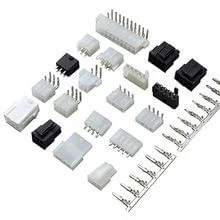
Mini-Fit family alternative catalog examples. The group is not a parts list for the classic Mini-Fit Jr. configuration compared above. View Mini-Fit family alternatives.
Molex's broader Mini-Fit page includes Plus HCS, BMI, TPA and other variants. Its 13 A headline must not be assigned automatically to a classic Jr. bill of materials. Plus HCS uses a distinct high-current terminal system, while TPA concerns terminal position assurance and BMI concerns blind-mating integration. Those differences answer different design needs. Molex Mini-Fit variants.
Record the actual part numbers before comparing options. For example, 39012040 identifies a four-circuit, dual-row Mini-Fit Jr. receptacle housing; it does not identify the installed contact alloy, plating or wire. A housing-only reference therefore leaves essential electrical choices unresolved. Molex 5557 housing series.
Do not assume that a similarly shaped compatible connector inherits any of these Molex ratings. An alternative needs its own drawings, material and electrical specifications, followed by checks appropriate to the intended connection.
What changes if you move to Mega-Fit?
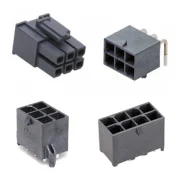
Mega-Fit alternative catalog components. Shown for identification only; original catalog ratings do not rate these pictured alternatives. View Mega-Fit alternatives.
Treat the change as an interface review with three decisions.
First, decide whether the mating side can change. If the board header is fixed, replacing only the cable end with Mega-Fit does not solve the connection. A proposed adapter adds another interface and still leaves the original connector in the power path.
Second, check installation space beyond the connector body. A heavier cable may need more room for bends, strain relief and access to the latch. Compare the actual mating drawings and the planned cable exit inside the enclosure rather than estimating from pitch alone.
Third, qualify the revised assembly against the load. The smallest electrical margin may be at a board trace, another connector or a branch, even after the main connector changes. Agree the representative sample configuration and acceptance conditions before treating the design as production-ready.
If your problem is reducing size rather than increasing current, the existing Micro-Fit 3.0 vs Mini-Fit Jr. comparison addresses a different selection direction.
Choose the appropriate sourcing route
Zeakka is a sourcing and supply partner coordinating cable assembly requirements and suitable suppliers. Original Molex components may be specified for a finished assembly; Zeakka does not offer original Molex loose components for standalone sale. Compatible alternatives should be identified separately in the quotation and reviewed against their own specifications.
For an established Jr. interface, see custom Mini-Fit cable assemblies. For alternative-component references, use the Mini-Fit connector page or the Mega-Fit connector page. These pages are enquiry routes, not confirmation that every original variant or rating is available.
Discuss a power-cable project: identify the existing connector pair and the current carried by each loaded circuit. That gives the review a clearer starting point than a request for a “higher-amp Molex cable.” Contact Zeakka.
Frequently asked questions
Can thicker wire increase a Mini-Fit Jr. connector's rating?
Not by itself. The terminal must accept the conductor and insulation, and the complete mating system must meet the required thermal conditions. Thicker wire does not upgrade the housing or contact system automatically.
Can a Mini-Fit Jr. cable plug into Mega-Fit?
No. They use different interfaces. Any transition requires a deliberately designed connection and review of the remaining power path.
Does a compatible Mega-Fit-style cable have the Molex maximum rating?
No automatic equivalence should be claimed. Use the proposed component supplier's data and validate the finished assembly for the intended application.
Related selection guides
Common Molex Connector Types Compared: PicoBlade, Pico-Lock, Pico-SPOX, Micro-Fit, Mini-Fit Jr. and Mega-Fit · Connector Current Ratings Explained: Wire Size, Circuit Loading and Temperature Rise
Share this article
Help others discover this content