
Overmold-to-Jacket Adhesion: What to Confirm Before Sampling
Table of Contents
A molded boot can look continuous with a cable while its interface remains unverified. The useful purchasing question is not “does TPU stick to PVC?” It is whether the proposed material grades, cable surface, geometry and manufacturing process produce the interface your assembly requires.
Decide what that interface must do before approving samples. Holding the cable, resisting repeated bending and restricting a leakage path are different requirements. One successful check does not establish all three. The cable overmolding process guide explains the overall manufacturing sequence; this guide focuses on the evidence needed at the jacket boundary.
Identify both materials beyond the family name
Request the cable manufacturer's construction reference and jacket grade where available, together with the proposed overmold compound and color formulation. If the jacket formulation is proprietary, record the available identification and ask the suppliers what compatibility evidence they can provide. An unknown grade should remain an explicit limitation in the review.
Avient's processing guidance identifies substrate formulation, color concentrate, moisture, surface preparation, processing conditions and part design as factors affecting adhesion for its overmolding TPEs. Its guidance is a reason to investigate the actual combination, not a qualification of a particular cable jacket.
Ask whether the sample and production cable will have the same surface condition. Printing, handling, storage and any proposed treatment belong in that discussion. Do not add a solvent, primer or abrasion step merely to improve an informal trial: the responsible suppliers need to confirm the permitted method and its effect on the complete construction.
Separate the bonding interface from mechanical retention
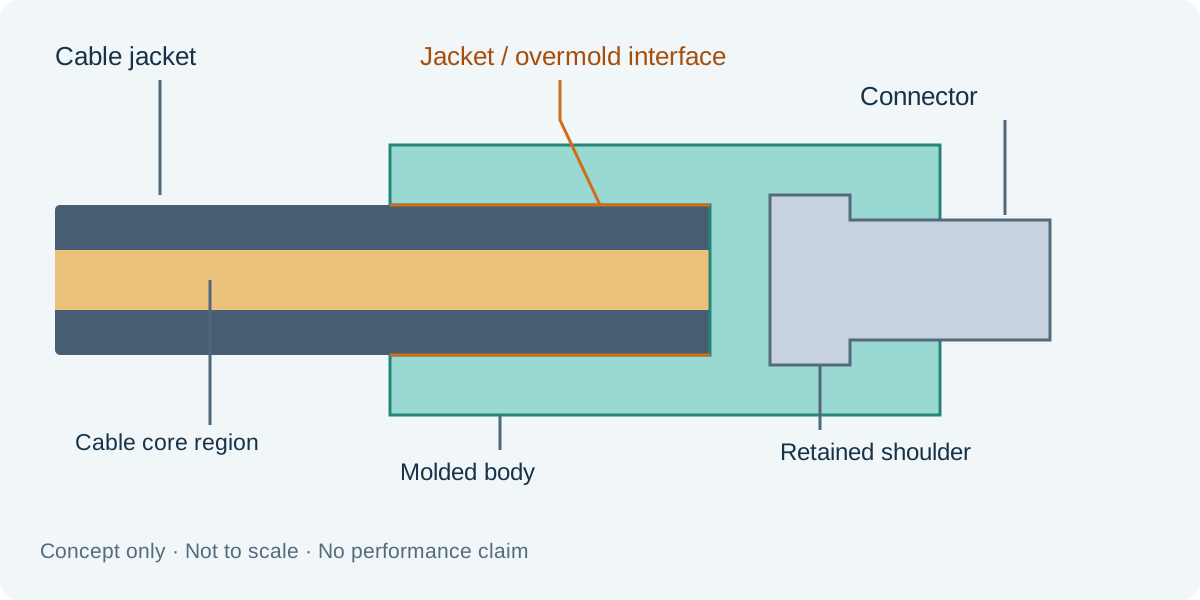
This illustration is a simplified concept, not a product drawing or recommended construction. The orange lines identify the jacket interface. The connector shoulder represents a separate geometric retention feature; it does not demonstrate bonding to the jacket.
A pull result can include several load paths. If the body grips a connector feature while the jacket boundary separates, the assembly might still resist a particular pull. Conversely, an interface can remain attached while another part of the cable fails. Ask the test report to identify where movement or damage occurred, not just the highest force recorded.
For sealing, identify the actual boundary that must resist the specified exposure. A visually closed interface is not a leakage test, and a mechanical interlock should not be treated as evidence of an environmental rating.
Agree the evidence before making the sample
Scroll sideways to read all columns.
| Review question | Input to agree | Evidence to retain |
|---|---|---|
| Is material compatibility supported? | Exact material identities and applicable supplier guidance | Written review and unresolved limitations |
| What interface is being evaluated? | Drawing revision, overlap region and surface condition | Annotated sample drawing and build record |
| What load matters? | Direction, fixture, rate, duration and acceptance criteria | Results plus observed failure or movement location |
| Does exposure change performance? | Relevant environment, conditioning and test sequence | Sample identities and before/after findings |
| Is sealing required? | Product condition, method and acceptance criteria | Results for the specified complete assembly |
| Can the result be repeated? | Agreed sample selection and production controls | Traceable sample and process records |
The responsible engineering team must select suitable methods and limits for the application. A peel-style coupon may help compare candidates if its preparation and measurement are defined, but it does not automatically represent the curved, constrained interface of the finished cable. Keep screening evidence separate from assembly approval.
Fictional review: a cable change with the same nominal diameter
EX-AD-51 revision A uses an invented cable reference CJ-A and compound OM-A. A proposed revision B replaces CJ-A with CJ-B while keeping the nominal outside diameter and external boot shape. All identifiers and decisions in this example are fictional.
Scroll sideways to read all columns.
| Item | Known position | Required decision |
|---|---|---|
| Cable identity | CJ-B comes from a different construction reference | Obtain jacket information and surface details |
| Geometry | Nominal diameter unchanged; tolerance not yet compared | Review actual diameter range and interface drawing |
| Initial pull | One informal sample stayed in place | Do not use as final approval; agree controlled test and sample selection |
| Interface observation | Small separation visible at the cable exit after bending | Record location and condition; investigate against agreed criteria |
| Environmental evidence | None for revision B | Define required conditioning and sealing evidence if applicable |
| Release | Revision A remains the released configuration | Hold revision B pending engineering disposition |
The review does not conclude that CJ-B is unsuitable. It identifies why the earlier approval cannot simply be transferred. A material trial, a geometry adjustment or a different candidate may be considered, with each change recorded so the result remains interpretable.
Preserve the approved combination for repeat orders
Reference the released cable, compound, drawing and approved process documentation in the production package. Define how a material substitution, color change or surface-treatment change is reviewed. The engineering change request template can help record the affected samples, orders and acceptance evidence.
Keep the report's conclusion within its tested scope. “Passed the agreed pull check” is more useful than “excellent adhesion” without a method. Where a required test remains pending, say so directly and retain the release restriction.
Frequently asked questions
Can polymer family names establish compatibility?
No. They are a starting point for selecting candidates. Exact grades, formulations, surface conditions, geometry and process evidence are needed for the proposed assembly.
Does a passing pull test prove sealing?
No. A pull test evaluates its specified mechanical condition. Sealing requires a separate agreed assessment of the relevant product configuration.
Must every material change repeat every test?
The responsible engineering team should assess the change and define the affected verification. Neither automatic full retesting nor automatic acceptance is justified solely by a matching family name.
Request an interface review
For custom overmolded cable assemblies, send the cable and compound references, interface drawing, application exposure and required acceptance evidence. Contact Zeakka to coordinate review with a suitable supplier. Bonding performance and any project-specific testing must be confirmed for the actual configuration.
Share this article
Help others discover this content