
Wire Insulation vs Cable Jacket: Choosing Materials for a Cable Assembly
Table of Contents
“Use PVC cable” leaves an important question unanswered: PVC where? The material surrounding each conductor and the outer layer surrounding a group of wires perform different jobs. A replacement can keep the same conductor gauge yet change termination fit, routing space or suitability for the installation.
Specify the required cable construction and service conditions before choosing a material label. Then check the particular wire, cable and termination documents together. This guide explains the layers and the decisions that belong on the assembly drawing; it does not provide a universal ranking of plastics.
Identify the layer before choosing the material
Conductor insulation surrounds an individual conductor and provides electrical separation under the wire's specified conditions. Its material, wall thickness and outside diameter are part of the wire construction. The conductor's AWG value alone does not describe any of these.
An overall jacket surrounds a cable core, which may contain individually insulated wires, pairs, shielding and fillers. It provides an outer covering for the construction. Its mechanical and environmental characteristics depend on the particular compound and cable design. A jacket is not automatically a substitute for the insulation required on each conductor.
A sleeve, heat-shrink tube or local overmold is another part of the assembly. These can protect or organize a transition, but adding one does not automatically give the underlying cable a new voltage rating, sealing classification or continuous-flex capability. For how those treatments carry mechanical loads, see the strain-relief guide.
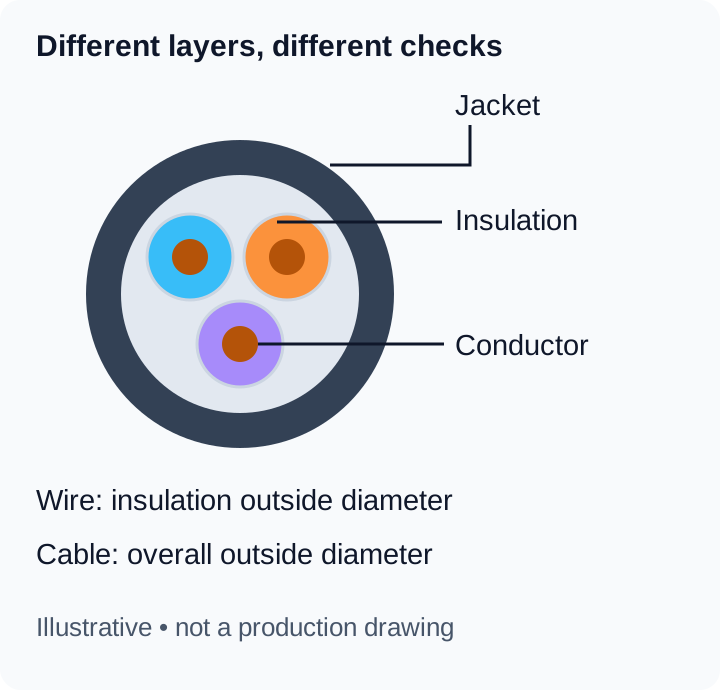
Illustrative layers only. The drawing is not to scale and does not define an approved cable construction, wall thickness or electrical rating.
Read separate construction fields, even when the material is the same
The official Alpha Wire 55291 construction table lists conductor insulation and the overall jacket separately, although both use FEP. It also lists the core wrap and shield separately. That is a useful way to read a cable specification: repeated material names do not make the layers interchangeable. This is a documentation example, not a statement that this cable is offered by Zeakka. Alpha Wire 55291 construction data
For a proposed substitute, compare each relevant field with the approved cable rather than matching only “FEP,” “PVC” or another polymer name. Compound formulation, dimensions and the complete cable construction matter alongside the base material.
Scroll sideways to read all columns.
| Selection question | Individual insulated wire | Overall cable and jacket |
|---|---|---|
| Will the termination accept it? | Check conductor construction, wire size, insulation outside diameter and the applicable termination process. | Check how much jacket must be removed and how the exposed wires reach their cavities. |
| Will it fit the installation? | Check wire routing and space between adjacent terminations. | Check overall diameter, bend requirements and clamp, gland or boot fit. |
| What touches the material? | Identify exposure inside the enclosure or at stripped cable ends. | Identify the external fluid, abrasion, sunlight or cleaning exposure where applicable. |
| Which evidence applies? | Use the exact wire specification and connector application requirements. | Use the exact cable specification and the equipment's installation requirements. |
Same AWG does not mean the same termination fit
Imagine a proposed replacement that retains the approved conductor gauge but has thicker insulation. The electrical conductor size may be unchanged while the insulated wire no longer fits the terminal's insulation support, a wire seal or the intended routing space. Conversely, a smaller insulated diameter may fall outside the approved support range. Neither result can be resolved from AWG alone.
The manufacturer may restrict both conductor size and insulation diameter for a contact or insulation-displacement connection. Check the exact combination, including strand construction and insulation characteristics when specified. Do not simply reuse strip lengths or processing settings from a different wire. The JST wire-gauge and current guide gives examples of why terminal-specific wire ranges matter.
Changing only the outer jacket can also affect the assembly: a different overall diameter may require a different clamp or boot, while a stiffer cable may need more room at the exit. Review these interfaces before approving the substitution, even when the pin mapping stays identical.
Translate the environment into specific requirements
“High temperature” is not yet a usable requirement. State the expected surrounding temperature, heat sources, electrical loading and whether the cable must move or be installed at the temperature in question. A material or cable temperature value is not automatically the permitted ambient temperature for a fully loaded connector assembly.
Similarly, name a relevant fluid or cleaning process rather than asking only for “chemical resistance.” Where exposure matters, provide concentration, contact duration, temperature and whether the assembly will flex during or after exposure. Ask for evidence that applies to the proposed cable and those conditions; a broad material description is not sufficient acceptance evidence.
For movement, distinguish occasional installation bending from repeated bending in service. Specify the routing, bend radius, travel and cycle expectations for review. Neither a soft jacket nor stranded copper alone proves suitability for continuous motion. The solid-versus-stranded guide explains why conductor construction is only one part of that decision.
Keep cable ratings and assembly approval separate
A cable datasheet can list different temperature values for physical properties and for particular approvals. Alpha Wire's 55291 page, for example, separates its properties section from its applicable-specifications section. Read the named specification and conditions instead of selecting the highest temperature appearing on the page.
The finished assembly also contains contacts, housings and possibly accessories with their own limits. A higher-rated cable does not raise their ratings. Any required installation classification, flammability approval or environmental qualification must be defined and verified for the intended use; an attractive material description cannot establish it.
Put the material decision on the drawing
Reference an approved wire or cable part number where one exists. Otherwise, state the information needed to review a candidate: conductor construction and gauge, individual insulation requirements, core arrangement, shielding if needed, overall jacket requirements and dimensional constraints. Add the termination references and the service conditions that drive the choice.
Define whether substitution is prohibited or requires written review. A change in compound, insulation diameter or jacket construction can affect different interfaces even when the assembly drawing's length and pinout do not change. Use the engineering-change guide to identify which previous conclusions need to be checked again.
For a custom discrete-wire cable assembly, send the drawing, existing wire or cable reference and the material requirements that are mandatory. Zeakka coordinates sourcing and supplier review; a material discussed here is not a promise of availability in every configuration. Request a project review to establish a documented candidate before treating it as an approved replacement.
Share this article
Help others discover this content