
Storing Cable Assemblies Before Installation
Table of Contents
A cable assembly can spend weeks or months between receiving and installation. During that interval, its identity, protective arrangement and storage conditions still matter. An unopened carton is not a universal guarantee of suitability, and opening a pack should not break the link between the remaining units and their records.
Start with the approved assembly and the requirements for its actual components and materials. Build a storage instruction around that information rather than assigning every cable the same temperature range or expiry date.
Preserve identity and exposure history when splitting a pack
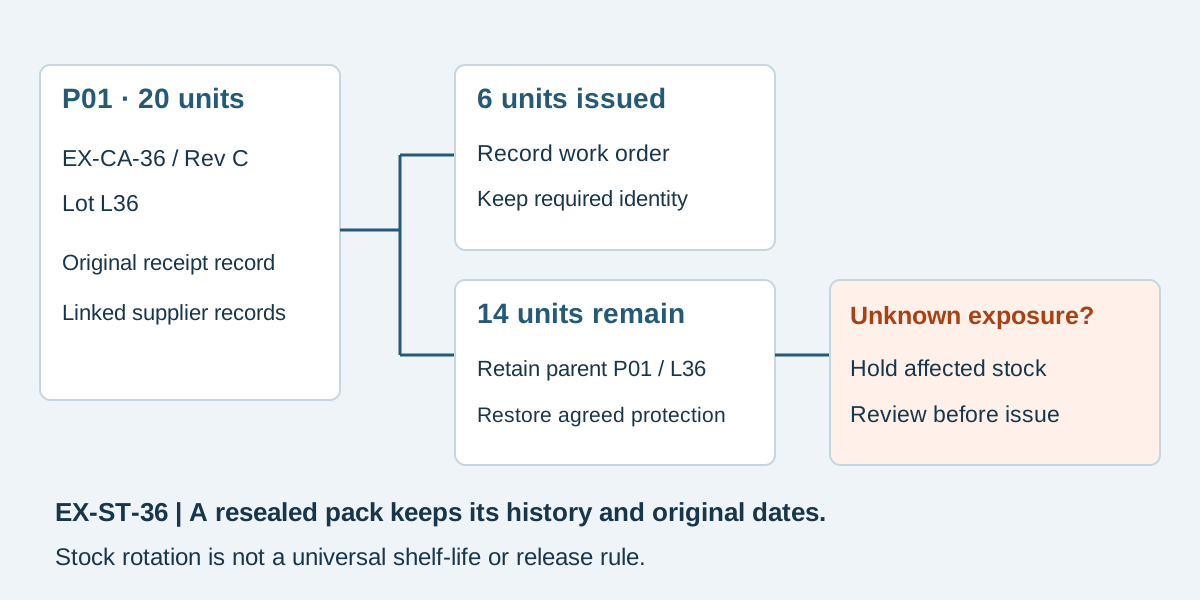
Fictional EX-ST-36 stock flow: pack P01 contains 20 units of revision C, lot L36; six are issued and fourteen remain. An unknown exposure affecting the remainder requires a hold and review, with original dates retained.
Conceptual illustration. Fictional examples are not approved product configurations, tooling instructions or inspection results.
Gather the requirements for the complete assembly
Review the cable jacket and insulation, connector housings and contacts, seals, labels, sleeves and any included electronics. Identify the relevant manufacturer handling or storage instructions and the supplier's agreed finished-assembly requirements. Requirements for loose components may inform the review but do not automatically define a finished harness's complete storage specification.
Separate operating ratings from storage conditions. A connector's operating temperature range is not an instruction to store a packed cable at either extreme. Likewise, a sealed connector rating in its specified mated condition does not establish the protection of an unmated connector in a warehouse.
As one specific example, TE application specification 114-16017, Rev R, section 3.2 discusses storage for Mini-Universal MATE-N-LOK products. It addresses ultraviolet exposure, retaining shipping containers until use, first-in-first-out use, sealed bags for seals and listed chemical exposures. Those are product-specific instructions, not a universal cable-storage schedule or a numerical shelf life for every assembly.
Use the current applicable documents for the exact order. If storage limits or an exposure decision are missing, request clarification from the supplier before treating an informal warehouse habit as an approved condition.
Make the stock location support the protection plan
Keep the approved arrangement from carrying avoidable loads through contacts, latches or cable exits. A storage bin should support the pack rather than compress its vulnerable parts. Do not hang a harness from a connector unless the approved handling arrangement explicitly permits that load path.
Preserve the permitted coil or branch arrangement. Forcing a long assembly into a smaller bin can change the bend and restraint conditions agreed for its packaging. Use the bend-radius guide to distinguish the cable's documented handling needs from an arbitrary convenient coil size.
The packaging guide covers shipment protection and receiving inputs. Storage adds the later question: who preserves that protection after the carton is opened and over successive withdrawals? Assign an owner for location conditions, pack integrity and exceptions.
Where a defined temperature, humidity, light or contamination control is required, identify the limit, monitoring responsibility and record location. Do not invent a room-condition target simply to fill an empty field. A requirement without a monitoring or exception process is difficult to apply consistently.
Preserve identity when a pack is split
The remaining stock needs the assembly reference, revision, lot or serial relationship, quantity and required records. A new bag marked only “spare cables” loses information needed for installation and later investigation.
EX-ST-36 is a fictional stock transaction for assembly EX-CA-36 revision C, lot L36. Twenty units arrive in pack P01. Six are issued to a named work order, leaving fourteen in storage. These quantities illustrate recordkeeping, not a recommended pack size.
Scroll sideways to read all columns.
| Stock event | Record to retain | Protection action |
|---|---|---|
| P01 contains 20 units | Part, revision, lot, received date and linked supplier records | Keep the approved packing arrangement |
| Six units issued | Work order and issued quantity; unit identities if required | Transfer with the required handling information |
| Fourteen units remain | Parent P01, remaining quantity, split date and storage location | Restore the agreed protective arrangement and identification |
| Package found open after an unknown interval | Discovery date, affected quantity, known conditions and missing information | Segregate pending the defined review; do not invent an exposure duration |
Resealing a pack does not reset a material expiry date or erase its exposure history. If a specific packaging system has controlled opening and resealing requirements, follow those instructions. Adding a generic bag, desiccant or protective cap does not demonstrate an equivalent system.
Use stock rotation without turning it into a lifetime claim
First-in-first-out rotation can help avoid leaving older stock unnoticed. Where an applicable product has a defined expiry or use-by basis, the stock process must also respect that requirement. Record what starts the relevant period: manufacture, receipt, opening or another documented event. These dates are not interchangeable.
Do not create an expiry date by adding an arbitrary number of months to the delivery date. Conversely, lack of a printed expiry date is not proof of unlimited storage. Ask what conditions and evidence support continued use for the particular materials and configuration.
Keep design revision control alongside age control. The oldest acceptable stock may belong to a revision no longer approved for the current equipment. A rotation rule cannot override the released installation configuration.
Review exceptions before issuing stock
An exposure outside the defined conditions, missing identity, damaged protection or an unknown history should trigger the agreed hold-and-review process. Identify the affected packs and preserve the available evidence. The reviewer may need supplier guidance, further inspection or a defined test; the response depends on the actual issue.
Do not clean contacts, add lubricant, dry materials with heat or replace seals using an improvised recovery method. Such actions can change materials and evidence. Obtain an approved disposition and record any authorized action against the affected stock identity.
A simple continuity pass cannot establish that every storage-related concern is resolved. It does not identify a changed seal, recover missing material traceability or demonstrate an environmental property. Any additional verification should address the specific concern and applicable requirements.
Check readiness at the point of use
Before installation, confirm the required revision and stock status, reconcile the assembly identity with the records and inspect the features identified by the handling plan. Look for discrepancies that require review rather than treating a visual check as complete product qualification.
Make the handover clear: who releases held stock, who removes temporary protection, and which instructions travel with the assembly? Maintain traceability for unused units returned from production. Their conditions and pack history may differ from stock that never left storage.
Frequently asked questions
Is there a standard shelf life for all cable assemblies?
No universal period is supplied here. Review the actual materials, component instructions, packaging conditions and agreed finished-assembly requirements.
Does resealing the original bag restart the storage period?
No. Preserve the relevant original dates and exposure history. Follow any specific opening and resealing requirements for the approved protective system.
Can old stock be released after it passes continuity?
That result addresses only its recorded electrical check. Identity, revision, condition and any material or exposure questions still require their agreed review.
Define storage needs before ordering
For custom cable assemblies, include expected storage duration, warehouse conditions, partial-pack handling and any required pre-use review in the RFQ. Zeakka coordinates supplier clarification as a trading partner. Contact Zeakka with the known conditions and unresolved fields so the proposed protection and documentation can be confirmed.
Share this article
Help others discover this content