
How Many Cable Assembly Samples Should You Request?
Table of Contents
The useful sample quantity is the number needed to answer the project's defined questions. Asking for a customary number before defining those questions can leave a team with too few specimens for destructive examination, no untouched reference, or several identical samples that never test the installation variant that matters.
Build a quantity plan from the evaluation tasks, the construction variants and the permitted sequence of use. This is a planning exercise for the project. It does not establish a statistical sample size, qualification program, supplier minimum order quantity or universal minimum number of prototypes.
Separate sample uses before adding up the quantity
Illustrative allocation groups. The required quantity depends on the agreed validation plan.
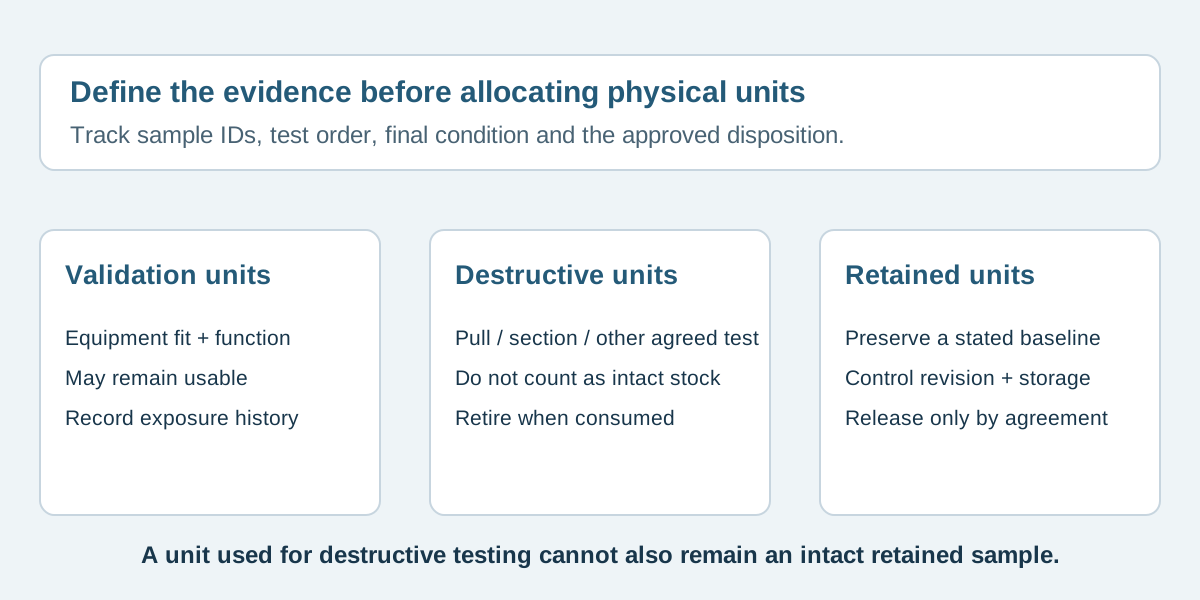
Conceptual illustration. Fictional examples are not approved product configurations, tooling instructions or inspection results.
Start with the decisions the samples must support
List the decisions first: connector access in an enclosure, branch reach, circuit assignment, a defined electrical measurement, examination of a termination or review of a proposed material change. For each task, identify the responsible reviewer, relevant assembly revision and required equipment configuration.
Then identify the applicable method and acceptance criteria. A quantity cannot compensate for an undefined measurement boundary or an unapproved drawing. Link the plan to the sample approval checklist, which records the eventual decision, and use the quantity plan to make the required specimens available.
For formal validation, qualification or regulated work, the responsible engineering or quality authority must determine the applicable program and sample sizes. An informal prototype allocation should not be represented as compliance with a standard or as evidence of population reliability.
Separate reusable, consumed and retained specimens
A specimen can support several tasks only if their methods and order permit it. Classify the proposed work explicitly rather than assuming every check leaves the item unchanged.
Scroll sideways to read all columns.
| Specimen role | Planning question | Allocation consequence |
|---|---|---|
| Fit and visual review | Can the stated examination leave the assembly suitable for later work? | Sequential use may be possible with recorded history |
| Defined electrical examination | Do the method, fixtures or applied conditions affect later conclusions? | Reviewer must approve any sharing or sequence |
| Destructive examination | Will cutting, pulling to failure or sectioning consume the relevant construction? | Allocate dedicated specimens or approved sacrificial pieces |
| Retained reference | Must it remain available in its approved state? | Reserve it; do not borrow it for destructive work |
| Contingency specimen | Which defined event permits its use? | Keep its disposition visible rather than silently consuming it |
Molex's Industrial Crimp Quality Handbook, in its definitions of pull force testing, describes that method as destructive. Its scope also says general guidance does not replace individual product or tooling requirements. Use the applicable method to determine what is consumed; do not lift a numerical sampling recommendation into a different assembly's plan.
A fictional twelve-assembly allocation
This example is invented to explain counting. It is not a recommended minimum, a qualification plan or a Zeakka sample offer. EX-Q12 revision B has one four-wire construction. The project team has already approved the tasks and decided which specimens each task requires.
The team allocates 12 finished assemblies as follows. The two fit-review units also receive the team's specified initial visual and circuit checks before installation; they are not counted again as extra assemblies.
Scroll sideways to read all columns.
| Assembly IDs | Quantity | Assigned use | Later disposition |
|---|---|---|---|
| Q01–Q02 | 2 | Fit and access review in two identified equipment configurations | Keep their installed-use history; no destructive work planned |
| Q03–Q05 | 3 | Defined electrical examination using the agreed method and fixtures | Retain with results until review is closed |
| Q06–Q08 | 3 | Dedicated destructive termination examination agreed by the team | Consumed or altered; never relabel as untouched references |
| Q09–Q10 | 2 | Untouched references for customer and supplier record | Reserved, with matching identifiers and revision |
| Q11–Q12 | 2 | Contingency for a documented repeat or handling event | Remain unassigned until the reviewer authorizes use |
| Total | 12 | 2 + 3 + 3 + 2 + 2 | Every assembly has one primary allocation |
The counts are project choices for this fictional case. In particular, three destructive assemblies does not establish the number of individual crimps to examine. The reviewer must state the selected end, cavity, termination type and count, and whether one assembly supplies more than one relevant specimen.
If the three destructive assemblies each contain eight terminated ends, that means 24 terminated ends exist, not that 24 equivalent independent test specimens have been approved. Their wire, contact, position, processing history and selection method still matter.
Count mating hardware and sacrificial pieces separately
The assembly quantity is only one line of the evaluation bill. Identify compatible mating connectors, representative equipment boards, fixtures and any separate process specimens. Record who provides them and whether they are included in the quotation.
In the fictional plan, the equipment team supplies the mating hardware for Q01–Q02. The electrical reviewer defines the mating hardware for Q03–Q05. No extra finished assembly is added solely by calling that hardware a sample. If the destructive method needs separately prepared crimped leads, list their quantity and construction separately; do not silently substitute those leads for finished-assembly evidence.
JST's handling precautions call for assessing suitability in the user's equipment. For the quantity plan, the practical implication is to identify the actual equipment and mating configuration needed for the review. A stack of cable assemblies alone cannot resolve every system-level question.
Approve sharing and sequence before reducing the count
Suppose the fictional team wants Q01–Q02 to replace two electrical specimens, reducing the order from 12 to 10. That change is not just arithmetic. The electrical reviewer must determine whether the prior installation handling and mating history are acceptable for the intended measurement.
If the revised method requires an initial condition, the result from a previously handled specimen may answer a different question. Preserve the original plan until the responsible reviewer approves the changed sequence and identifiers. Record measurements before and after conditioning separately where the method requires them.
Similarly, a failed measurement does not automatically authorize consuming both contingency units until something passes. State the purpose of any repeat, preserve the original result and identify whether the repeat is checking a suspected measurement issue or evaluating a changed construction.
Keep variant coverage visible
A connector, wire or branch-length change can create a distinct review case. Do not divide the same twelve specimens across several constructions and continue describing the original plan as fully covered.
Use a variant matrix with the assembly revision, contact-wire combination, equipment configuration and task. Decide which evidence can apply across variants and which needs separate specimens. The responsible reviewer should explain the rationale; visual similarity alone is not enough to transfer approval.
When a supplier proposes a temporary prototype substitution, label it in the plan. Results from that specimen must be interpreted against the construction actually supplied. Keep the intended production BOM and outstanding verification decisions visible.
Frequently asked questions
Is three or five samples usually enough?
There is no universal answer. Count the tasks, consumed specimens, variants and retained references, then apply any governing test program. A supplier's commercial sample offer may be smaller or larger than the project's evaluation need.
Can one sample cover fit, continuity and destructive testing?
Possibly, if the responsible reviewers approve the sequence and accept its effect on each conclusion. Once it is destructively examined, it cannot continue serving as an intact fit specimen or untouched retained reference.
Does increasing sample quantity prove reliability?
Quantity alone does not establish reliability. A defensible conclusion also depends on specimen selection, construction representativeness, conditions, methods and the analysis appropriate to the intended claim.
Are these quantities Zeakka's MOQ or sample policy?
No. The twelve-assembly allocation is fictional. Sample quantity, charges, materials, feasibility and lead time require project-specific confirmation. Separately identify the quantities needed for evaluation and the supplier's commercial terms.
Request samples against an allocation plan
Contact Zeakka with the proposed assembly revision, variant list, evaluation tasks, required intact references and any planned destructive work. Name the decision owners and identify who provides mating hardware. Zeakka can coordinate supplier discussion around a defined request; testing arrangements, specimen preparation and delivery commitments remain subject to confirmation.
Share this article
Help others discover this content