
Pre-Crimped Leads vs Finished Cable Assemblies: Define the Handover
Table of Contents
A pre-crimped lead can remove a wire-termination operation from a customer's workbench without completing the cable assembly. Contacts may already be attached, but housing insertion, cavity selection, branch arrangement, identification and final verification can still remain.
Choose the supply boundary from the work that must be finished before delivery. A price for individual terminal-ended wires cannot be compared directly with a price for a released harness until the remaining assembly work, materials and acceptance responsibilities are visible.
Place the handover before or after housing insertion and verification
Conceptual supply boundaries for EX-HO-30. Terminal-ended leads still need controlled housing insertion and completed-map checks. Neither drawing represents a stocked Zeakka product.
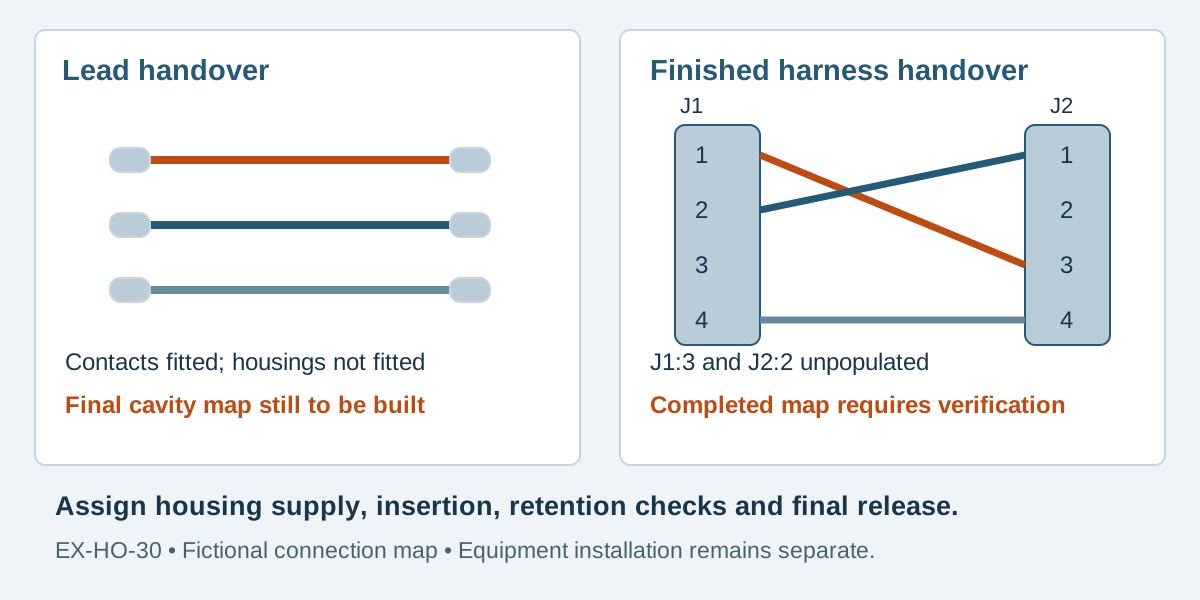
Conceptual illustration. Fictional examples are not approved product configurations, tooling instructions or inspection results.
Identify what the delivered item contains
The phrase “pre-crimped” describes an operation already performed on a wire end. It does not by itself say that both ends are terminated, that housings are included, or that the finished connection map has been verified. Read the exact item description and drawing.
For a concrete identity example, Molex 2175002122 is described as a Micro-Lock Plus 2.0 female-to-female pre-crimped lead, 150.00 mm long, 22 AWG and red. Its product record identifies the configuration as a pre-crimped lead only. A female terminal at each end is not the same as two assembled multi-position receptacle housings.
Molex's pre-crimped lead overview also distinguishes different end configurations, including pigtails. Therefore, “pre-crimped lead” is a category, not a complete purchasing specification. Do not copy a family-level length range or current figure into an order for an unidentified item.
Compare the remaining work
Scroll sideways to read all columns.
| Work item | Terminal-ended leads as the delivered item | Finished harness as the delivered item |
|---|---|---|
| Wire and contact identity | Defined for each lead | Defined within the assembly BOM |
| Housing insertion | Assigned to a downstream assembler unless included | Completed to the approved assembly definition |
| Cavity mapping | Must be implemented after handover | Implemented and checked against the agreed map |
| Branches, sleeves and labels | Separate materials and operations unless specified | Included only where the drawing and order require them |
| Final assembly acceptance | Cannot be inferred from individual lead inspection | Defined for the completed configuration |
| Equipment installation | Still a customer operation unless expressly included | Still a customer operation unless expressly included |
The last row matters. A finished harness is finished to its drawing, not necessarily installed and functionally validated in the customer's equipment. Keep the assembly testing scope separate from the equipment commissioning plan.
A fictional four-position handover
EX-HO-30 defines a hypothetical assembly with two four-position housings. Three leads connect J1:1 to J2:3, J1:2 to J2:1 and J1:4 to J2:4. J1:3 and J2:2 remain unpopulated. This is an illustration of responsibilities, not a recommended circuit or stocked product.
Under Route A, the customer receives three identified leads and obtains the approved housings separately. The customer's assembly team inserts each contact according to the controlled mating-view drawing, confirms retention by the specified method, checks the two empty positions and verifies the completed map. The lead supplier's evidence concerns the delivered lead configuration; it cannot demonstrate which cavities the customer subsequently populated.
Under Route B, the supplier delivers the assembled harness to EX-HO-30. Its scope includes the specified housings, the same mapping and the agreed inspection and electrical checks before release. Equipment mounting remains outside that handover. Both routes can reach the same final configuration, but they have different material, training and verification boundaries.
Scroll sideways to read all columns.
| Handover decision | Route A: leads | Route B: finished harness |
|---|---|---|
| Purchasing unit | Identified lead items and quantities | One assembly part number and revision |
| Housing supply | Named customer responsibility | Included in the agreed BOM |
| Mapping owner | Customer performs and verifies insertion | Supplier performs to customer-approved map |
| Evidence at receipt | Lead identity, quantity and agreed lead checks | Assembly identity and agreed completion records |
| Unused positions | Checked after downstream insertion | Checked before harness release |
This comparison is useful even when all three leads use the same wire color. Color alone cannot identify their destination after unpacking. Agree lead identifiers or controlled handling where required, and use the pinout guide to prevent a mating-view and wire-entry-view reversal.
Preserve length and end definitions
A catalog lead length and a finished harness length can use different datums. Establish whether the length refers to wire cut length, a contact reference or a completed connector reference. Do not assume insertion into a housing leaves the quoted finished dimension unchanged.
For a pigtail, define the uncrimped end separately: preparation, exposed conductor length where applicable, protection and the downstream termination. If a proposed process cuts a dual-ended lead into two pieces, the resulting lengths, end preparation, identification and acceptance need a new controlled definition. The catalog description does not approve the downstream modification.
Contact protection also changes after handover. Loose terminated ends should arrive and move through assembly without damage or contamination that compromises their use. Specify the packaging and handling requirement for the actual contact and receiving process rather than assuming a bag of loose wires is adequate.
Compare cost at the completed-assembly boundary
Include the remaining housings, downstream labour, insertion instructions, fixtures if needed, verification, packaging and management of incomplete sets. A lead purchase can suit a controlled prototyping or assembly process. It can also transfer work to a team that has no approved insertion or test procedure.
Ask each quote to state what is included and excluded. Do not assign a universal saving percentage or assume either route has a lower minimum order. Availability, quantities and the selected process determine the commercial result. The cable assembly cost guide discusses the broader quotation inputs.
Supply-boundary questions
Are pre-crimped leads ready to plug into equipment?
Not necessarily. They may require housing insertion and other operations before they form the intended connectorized assembly. Check the exact delivered configuration.
Does a tested lead eliminate final harness testing?
No. Subsequent insertion can create a wrong cavity assignment or other assembly issue. Define verification for the completed map and configuration separately.
Can I request original branded leads from Zeakka as loose items?
This guide does not establish a loose-original-component or semi-finished-lead offer. Original branded parts are considered within finished cable assemblies; other supply boundaries require explicit project review.
State the handover in the RFQ
Send the required delivered condition, assembly drawing, connection map, part references, quantities and the operations your team intends to perform. For custom cable assemblies, ask Zeakka to review the completed supply scope. Zeakka coordinates sourcing as a trading partner; a proposed alternative or intermediate supply stage must be confirmed before it becomes an order assumption.
Share this article
Help others discover this content