
Reel vs Loose Piece Crimp Contacts
Table of Contents
A loose contact and a contact on a reel may serve the same connector system, but they do not reach the crimp tool in the same way. The supply format affects ordering, feeding, separation from the carrier and the tooling route that must be verified.
For a finished cable project, keep the required contact identity distinct from the supplier's proposed processing method. Approve any change using exact manufacturer references and applicable documents, especially when moving from manually prepared samples to a production applicator.
Match the contact format to the tool
Reel-to-hand-tool conversion requires a documented compatible route.
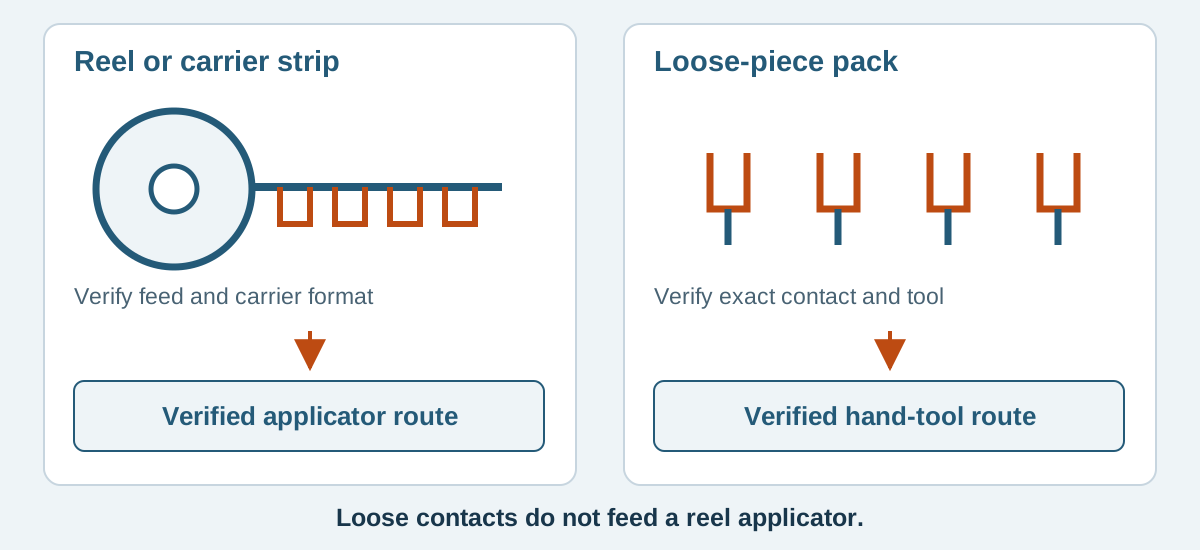
Conceptual illustration. It does not depict an approved product configuration or test result.
Compare supply format and process together
A reel normally carries contacts in a continuous feed arrangement. Loose-piece packaging contains separated contacts. A cut strip is a third description: it is a length removed from continuous material, not necessarily an original loose-piece packaging variant.
Scroll sideways to read all columns.
| Format | What to establish | Procurement risk to resolve |
|---|---|---|
| Manufacturer reel | Exact part, carrier configuration, feed and applicable applicator | A tool that handles the series may not handle this supplied variant |
| Manufacturer loose-piece pack | Exact loose-piece reference and applicable hand tool | The order may select the wrong wire range or finish |
| Cut strip from a reel | Original identity, traceability, carrier condition and intended tool route | A short strip may not suit the production feeding arrangement |
| Contacts separated from strip | Approved separation method, remaining tab and compatible hand tool | Informal cutting can damage geometry or leave an unsuitable tab |
This is a review checklist, not permission to convert any contact into any other format.
A documented example uses different part numbers
The Molex 43030 series chart lists 43030-0001 as a tin-plated female Micro-Fit 3.0 contact, 24–20 AWG, in reel packaging. It lists 43030-0007 with the corresponding wire-range and finish description in bag packaging. The 43030-0007 product page identifies 0430300001 as its reel packaging alternative.
That is a useful documented relationship. It does not establish a universal rule for changing the last digit of a Molex reference.
The series chart also lists 43030-0008 as a gold-plated bag-packaged option. A similar suffix can therefore identify more than the desired feed format. Preserve the full reference until the manufacturer documentation establishes the relationship.
These examples explain procurement. They do not establish stock, current lead time, tool compatibility for your wire or a rating for your finished cable.
Verify the tool against the supplied contact
Molex's tooling FAQ distinguishes loose-piece hand-tool routes from applicator routes. It says loose parts cannot feed an applicator and identifies a center-carrier restriction on separating contacts for hand tools. Where a permitted reel contact is separated for a hand tool, the actual terminal and tool combination still needs confirmation.
In a project review, request the proposed hand tool or applicator reference and the relevant specification. Check that the identified contact, conductor construction and insulation dimensions fall within that documented combination. A tool described as “Micro-Fit crimper” is too vague to complete this review.
Keep the press and applicator distinct in the record. Naming a press does not by itself identify the terminal-forming and feeding setup. Ask the supplier to identify the relevant equipment combination rather than substituting a photograph of a machine for the tooling reference.
Make sample to production changes visible
A small sample order may use a different preparation route from a later production batch. The transition should identify what changes and what must be verified again.
The following planning example is fictional. It is not an approved Molex process or a Zeakka capability commitment.
Example project C-207: twenty sample assemblies, each containing six contacts, followed by a proposed first production batch of five hundred assemblies. The customer requires the specified original contact system in the finished cable. The sample proposal uses the documented bag-packaged reference; the production proposal requests approval for its documented reel alternative.
Scroll sideways to read all columns.
| Review point | Sample proposal | Production proposal and approval action |
|---|---|---|
| Contact reference | Exact bag-packaged part is recorded | Record exact reel reference and the manufacturer's packaging relationship |
| Wire | Customer wire W-207 revision A | Preserve specification and verify any new material lot |
| Processing | Identified hand tool and applicable instructions | Identify applicator, press arrangement and applicable setup requirements |
| Verification | Agreed sample inspection records | Review the changed process and agree required evidence before release |
| Assembly definition | Drawing C-207 revision A | Keep pinout and dimensions unchanged unless a separate change is approved |
| Traceability | Contact pack label and wire lot | Record reel label, material lot and production batch link |
Do not release production with only “same connector as sample” in the purchase order. The supplier needs an approved definition of any packaging and process changes. The crimp inspection guide explains how the resulting evidence can be reviewed.
Separate contact consumption from the purchase pack
For the fictional C-207 example, twenty samples at six contacts each require 120 contacts installed in finished samples. Five hundred production assemblies require 3,000 installed contacts. Those counts exclude setup pieces, destructive-test specimens and any agreed allowance.
Do not add an arbitrary percentage and call it a manufacturer requirement. Ask the supplier to state separately what is proposed for setup and verification, how component packaging affects procurement, and how unused material will be handled.
A reel quantity also does not become a finished-cable minimum order quantity automatically. A quotation may reflect component procurement and process costs, but the commercial basis must be stated for that particular order. The low-volume assembly page provides the appropriate place to discuss sample and production quantities.
If a customer supplies contacts, agree who checks identity, packaging condition and available quantity before work starts. Resolve how unsuitable or insufficient material will affect the schedule instead of treating all supplied metal contacts as interchangeable stock.
Keep original and alternative requests separate
For an original-component finished assembly, retain the manufacturer part references, permitted packaging alternatives and traceability requirements. If an alternative is proposed, record its own manufacturer or supplier reference, wire compatibility, tooling requirements and approval evidence.
Do not carry original-component ratings, crimp parameters or certification claims onto an unbranded alternative because its housing fit looks similar. Packaging equivalence within one documented original series and substitution by another product are different approval decisions.
Zeakka is a trading and sourcing partner. Original JST or Molex components may be considered within finished cable assemblies according to the exact project and availability. Loose-component requests concern unbranded compatible candidates; this article is not an offer to sell original branded loose contacts.
Frequently asked questions
Can a loose-piece contact be loaded into a reel applicator?
Do not assume it can. The tooling must support the actual supplied format. Obtain confirmation through the applicable tool documentation.
Can I order the reel reference and cut contacts off for samples?
Only follow a documented route compatible with the actual terminal and hand tool. Carrier design and separation quality matter; do not treat hand cutting as universally permitted.
Do reel and bag references always have identical specifications?
No. Verify the full references and the manufacturer's documented relationship. Similar suffixes can also distinguish finish, wire range or other features.
For a finished assembly, send Zeakka the exact contacts, wire details and sample and production quantities. Mark which packaging alternatives are acceptable and which substitutions require approval. For loose compatible-component enquiries, begin with compatible connector alternatives and the required verification scope.
Share this article
Help others discover this content