
Connector Identification Worksheet
Table of Contents
An unclear photo and a description such as “four-pin JST” leave several questions unanswered: which interface is shown, how its contacts are retained, what it mates with and whether the original part reference is known. A structured identification record helps a supplier investigate those questions without turning a visual guess into an approved purchase specification.
Download the editable identification workbook. It includes a blank record, a fictional completed record and a pitch calculation based on the measured span across one row of positions.
Record observations before identifying a connector
Four contact centres contain three intervals. Keep a scale in the feature plane.
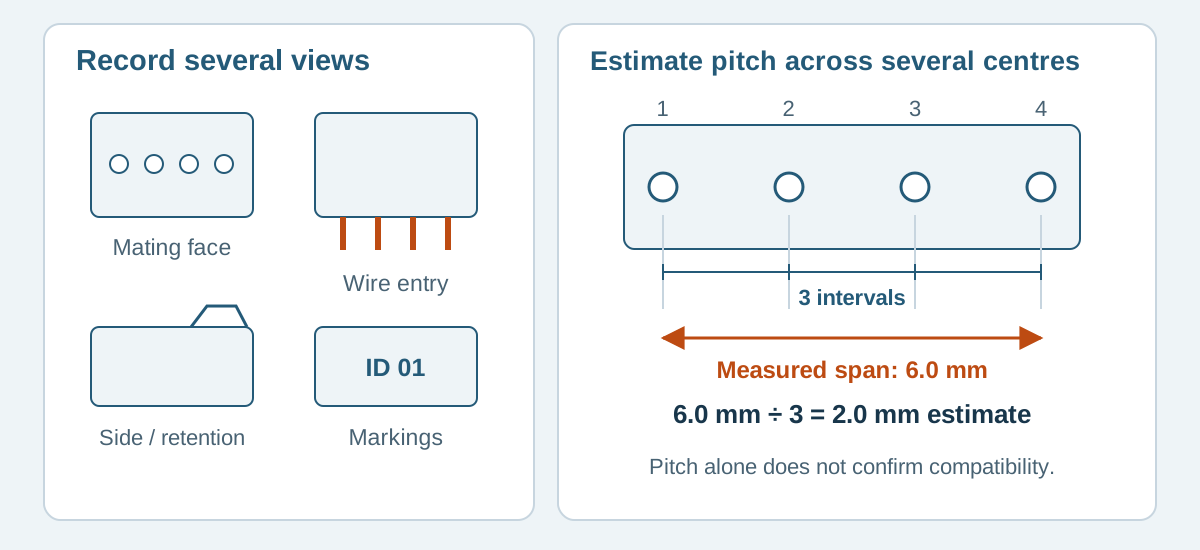
Conceptual illustration. It does not depict an approved product configuration or test result.
Give the sample a stable identity
Assign a sample or equipment reference before taking photographs. Keep that identifier in each filename or in the photo index. Note whether the sample is new, used, damaged or previously repaired. A broken latch or worn marking may no longer represent the original configuration.
Separate observations from suspected identity. “Four cavities in one row” is an observation. A manufacturer's name inferred from a white housing is a hypothesis. A released supplier drawing with an exact reference is documentary evidence. Keep these in different fields so that later reviewers can see what is established.
The worksheet is useful alongside the common JST connector overview, which explains selected families. It collects the information needed for a specific sample rather than assigning a family from appearance.
Take a consistent set of photos
Scroll sideways to read all columns.
| Photo | Show | Keep visible |
|---|---|---|
| P01 mating face | Cavities and interface features straight on | Full cavity pattern, orientation and surrounding housing |
| P02 wire-entry side | The opposite side of the same sample | Occupied and empty cavities, wire markings where readable |
| P03 side view | Retention, polarization and cable exit | The relevant profile without a finger covering the feature |
| P04 markings | Moulded text, logo or package label | Exact characters and the part of the sample carrying them |
| P05 dimension | Several contact centres and a scale | Scale in the feature's plane, with endpoints identified |
| P06 wire | Marking and a suitable diameter measurement | Which wire was measured and the measurement method |
| P07 mating part | Board-side or cable-side mate | Part reference, mounting arrangement and installed orientation |
Use original, focused images with even lighting. A collage is helpful for an overview, but retain the individual files so that small features can be examined. Avoid perspective views for dimension estimates. Isolate equipment and follow its handling procedure before gaining access; a hidden view does not justify forcing a connector apart.
Measure pitch across several gaps
For equally spaced positions in a single straight row, the estimated pitch is the centre span divided by the number of gaps. Four positions contain three gaps. A 6.0 mm span across those positions therefore gives an estimated 2.0 mm pitch.
This is a fictional geometry example, not identification of the example connector. The worksheet requires more than one position and a positive numeric span before calculating. For a single cavity, staggered pattern or mixed-spacing interface, leave the simple calculation unused and provide a drawing or a separate dimensioned sketch.
State the measuring method and uncertainty. A scale photo can narrow a search while remaining unsuitable for verifying a drawing tolerance. Measure housing width, height and depth separately; outside housing width is not contact pitch.
JST's public search uses category, pitch and series as search fields. Its PH catalogue then distinguishes contacts, housings and multiple header constructions. Those are useful successive checks: narrow the search, then compare the exact interface and components. Neither a search result nor a pitch match establishes interchangeability. JST product search, PH catalogue
Complete the fictional example
The filled record labels its sample EX-ID-001. It observes one row with four cavities, three occupied positions and an illustrative 6.0 mm span across the four centres. The workbook calculates 2.0 mm pitch. The manufacturer, family, wire size and board-side reference remain unknown.
The next action is to obtain a sharper marking photo, document the empty cavity and find the board-side part reference. It is not to order a PH connector because a catalogue also lists 2.0 mm pitch. The example deliberately leaves those identity questions open so that a useful measurement is preserved without overstating its conclusion.
Scroll sideways to read all columns.
| Record status | Example entry | Next action |
|---|---|---|
| Observed | Four positions; three occupied | Mark cavity view and empty position |
| Measured for search | 6.0 mm across three gaps | Establish instrument and uncertainty |
| Suspected | Manufacturer unknown | Obtain readable markings and package evidence |
| Candidate | None selected | Compare exact drawings and mating references |
| Approved configuration | Not established | Agree fit, wiring and application validation |
Review the mating system
A cable-side housing alone cannot define the complete connection. Provide the corresponding board or cable mate, contact reference, position count, keying, retention and available drawing revision. Record whether the mating part is already installed and must remain unchanged.
For wire-to-board parts, photograph the board side and describe its entry direction and mounting construction. For wire-to-wire parts, identify both halves. Do not infer conductor size from insulation thickness or carry an original manufacturer's ratings over to an unverified candidate.
Use the connector alternative review when assessing an unbranded candidate. Document the differences and agree required validation. Keep part identification separate from the pinout and cavity-view review: recognizing a housing does not verify how a finished harness is wired.
Submit the record for sourcing review
Send the completed workbook, original photos, known drawing or BOM references and your required supply scope. Say whether you need an unbranded compatible component candidate or a finished cable assembly. If original branded parts are required within the assembly, retain the exact references for project-specific availability review.
Zeakka coordinates sourcing as a trading partner. Original branded components are considered within finished cable assemblies, not sold separately as loose parts. To review a candidate and its mating requirements, send the record with your enquiry.
Common questions
Can a clear photo identify an exact part?
It may reveal a useful marking or geometry. Exact identification can still require the mating part, drawing, dimensions or packaging reference. Record the evidence supporting the proposed match.
Should I fill every unknown field before asking?
No. Submit the known observations and label unknowns. A concise open-question list is more useful than guessed measurements or references.
Does the calculated pitch confirm compatibility?
No. Review the complete interface, contacts, wire requirements and application evidence for the exact proposed combination.
Share this article
Help others discover this content