
Bare vs Tinned Copper Strands in Cable Assemblies
Table of Contents
Bare copper and tinned copper describe the conductor material or coating, not whether the wire is solid or stranded, and not whether its delivered end has been dipped in solder. For a cable assembly, the useful question is which documented wire construction fits the termination, installation and required evidence.
A request for “silver wire” or “tinned ends” cannot settle that choice. Identify the coating at the correct location, retain the complete wire specification and review any substitution before it reaches production.
Keep strand coating, end preparation and contact finish separate
Conceptual strand cross sections contrast uncoated copper with individual tin-coated copper strands. Separate callouts identify local solder preparation and connector contact plating; layer thickness is exaggerated.
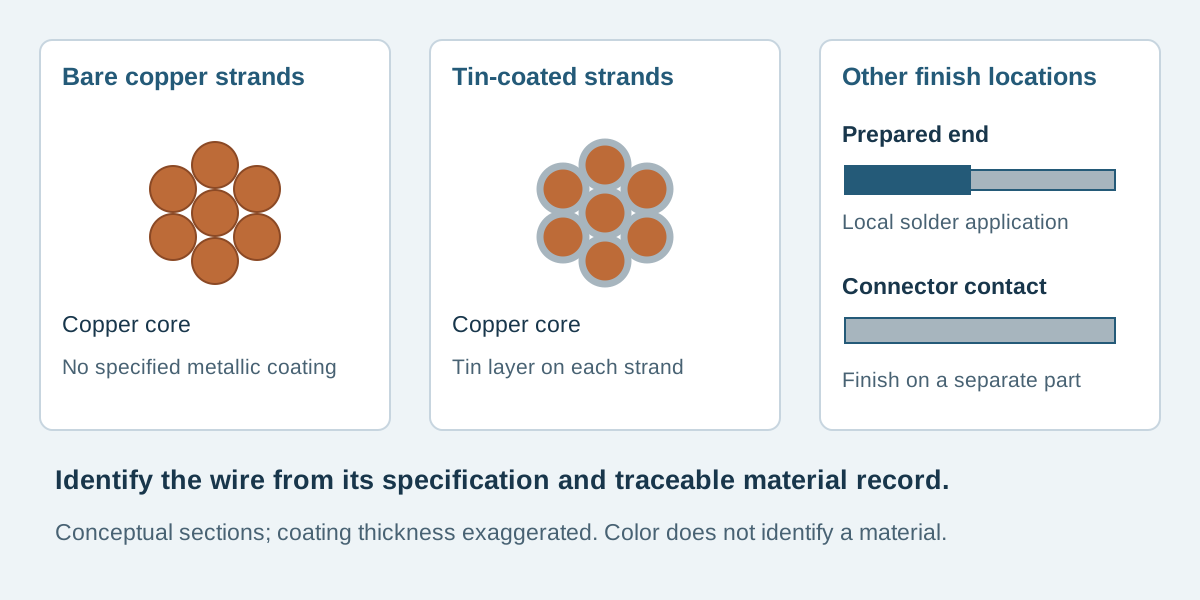
Conceptual illustration. Fictional examples are not approved product configurations, tooling instructions or inspection results.
Separate three places where a finish may appear
An insulated wire can contain bare copper strands: “bare” describes the copper surface beneath the insulation, not an instruction to supply an uninsulated wire. In a conventional tinned-strand construction, each copper strand has a tin coating. The copper remains the conductor core.
That is different from applying solder to a stripped end during assembly. It is also different from specifying tin or another finish on a separate connector contact. One assembly can involve all three decisions, but they need separate records.
Scroll sideways to read all columns.
| Decision | Where it applies | Where to record it |
|---|---|---|
| Bare or tin-coated copper | Wire conductor construction | Wire manufacturer's full part number and material specification |
| Stripped or solder-tinned end | Local end preparation | End schedule, process reference and preparation dimensions |
| Contact plating | Separate terminal or contact | Complete contact reference and applicable drawing |
The prepared wire-end guide addresses local end preparation. The solid versus stranded guide addresses conductor structure and movement. Neither decision substitutes for the material identification discussed here.
Read the conductor field, not just the product photograph
Manufacturer documents show why these fields should stay separate. The Belden 6712 product record identifies a 24 AWG conductor with 7×32 stranding and TC, meaning tinned copper. Its insulation is listed separately. Those fields identify one construction; they do not establish that another 24 AWG wire has equivalent insulation dimensions or termination behavior.
For a broader distinction, Alpha Wire's hook-up wire catalog lists bare and tinned conductor options alongside different insulation systems. Treat material, strand construction and insulation as independent specification fields rather than reducing a wire to its color and gauge.
Record the manufacturer's terminology exactly. Other constructions, including overcoated or bonded strands, require their own identification; do not quietly replace a specified individually coated strand construction with a product described only as “tinned.” Request clarification if the data sheet does not establish the coating arrangement needed by the design.
State the reason for the coating choice
Tin coating can be selected for solderability or corrosion-related requirements. Alpha Wire's technical training manual discusses these roles and distinguishes several coated conductor constructions. This is background, not an environmental approval for a finished cable.
Convert the application need into a reviewable requirement. Describe the exposure, temperature conditions, termination method and required supporting documentation. “More corrosion resistant” without an exposure or acceptance basis cannot define an approved substitution. A tin-coated conductor is not an enclosure seal, and it does not prove that moisture cannot enter a termination.
Likewise, do not assign an operating temperature from the conductor's appearance. Insulation, other assembly materials and applicable product ratings still matter. A coating name does not establish a flame classification, marine approval or permission for continuous flexing.
If there is no application reason to change the approved wire, a preferred appearance alone is a weak basis for a new material specification. Ask whether the proposed difference solves an actual requirement and what evidence would support acceptance.
A fictional wire-record comparison
Consider EX-CU-24, an invented two-wire assembly review. W-A and W-B are fictional candidate codes, not orderable products. The customer has already selected nominal 24 AWG stranded wire, but has not released the conductor coating or receiving contact combination.
Scroll sideways to read all columns.
| Record field | Candidate W-A | Candidate W-B | Release action |
|---|---|---|---|
| Conductor material | Bare copper strands | Individually tin-coated copper strands | Retain the chosen construction explicitly |
| Nominal size | 24 AWG | 24 AWG | Confirm actual manufacturer's specification |
| Strand construction | Not yet supplied | Not yet supplied | Obtain count, strand size and applicable construction |
| Insulation and diameter | Not yet supplied | Not yet supplied | Check against contact and insulation support |
| Delivered end | Stripped; no added solder | Stripped; no added solder | Record preparation separately |
| Receiving termination | Contact candidate C-1 | Contact candidate C-1 | Confirm applicability for each complete wire |
Both candidates have stripped ends without added solder. W-B therefore must not be described as a solder-dipped end. Matching nominal AWG and using the same contact candidate also do not make the two wires interchangeable.
The next useful supplier response is the exact wire specification and a documented termination review, not a photograph of a silver-colored bundle. If W-B arrives with a different strand count or insulation diameter, record those differences along with the coating change. Otherwise a review supposedly comparing copper finishes may actually be comparing several construction changes at once.
Review the complete termination combination
For a crimped end, provide the exact contact, wire specification, applicable tooling and required acceptance reference. Do not add solder before crimping to make bare strands resemble a tin-coated conductor. Any such preparation changes the termination process and needs explicit applicability evidence.
For a soldered connection, confirm the permitted preparation and assembly process for the actual materials. A wire described as tinned does not eliminate the need for a controlled soldering operation. For a clamped connection, follow the receiving component's instructions rather than assuming a solder-tinned end is acceptable because tin-coated wire is acceptable.
Separate material identification from performance evidence. A continuity result does not identify a coating, and a photograph does not demonstrate crimp quality. The crimp inspection evidence guide explains how to request evidence for the relevant characteristic.
Keep receiving inspection tied to the approved wire
Retain the approved manufacturer reference, document revision, reel or lot identification and any required certificate with the assembly record. Check that the incoming description matches the released conductor, stranding and insulation fields. Ask for clarification when a supplier substitutes a generic “copper wire” line for the agreed specification.
A visible mismatch can trigger investigation, but color is not a conclusive material test. Silver-colored surfaces may have other coatings or base constructions; lighting and surface condition also affect appearance. Use traceable documentation and, when required, an agreed identification method instead of approving material by photograph alone.
Frequently asked questions
Does bare copper mean there is no insulation?
Not in a conductor-material field. Bare copper strands can be surrounded by insulation. Specify insulation and delivered end preparation separately.
Is tin-coated stranded wire the same as a solder-tinned end?
No. One describes the wire's conductor construction; the other describes a local preparation operation. A tin-coated wire can still be delivered with a stripped end and no added solder.
Can tin-coated wire replace bare copper at the same AWG?
Treat it as a proposed change. Review the complete wire specification, receiving termination and application requirements before releasing it. Matching nominal size alone does not establish interchangeability.
Send the wire identity with the assembly request
For custom discrete-wire cable assemblies, send the approved wire reference or clearly marked candidate specifications, the reason for the coating requirement and the end-by-end termination schedule. Zeakka coordinates sourcing as a trading partner; material availability, termination feasibility and supporting evidence require project-specific confirmation. Contact Zeakka with unresolved fields marked so the quotation can identify them explicitly.
Share this article
Help others discover this content