
Connector Depinning: Decide What Must Be Replaced
Table of Contents
Depinning means removing a contact from its connector housing. It is different from unmating the connector halves, and different from removing a wire from its crimp. A tool that releases a retention feature does not establish that the extracted contact, housing or shortened wire can be used again.
Before authorizing rework, identify the exact connector and contact, obtain the applicable removal instructions, and decide the replacement scope. For an unidentified or damaged assembly, preserve the condition before attempting removal. The result should be a controlled repair decision, with evidence for the revised assembly.
Confirm the repair boundary before extracting a contact
A decision sequence for review. This diagram does not show an extraction technique or authorize reuse.
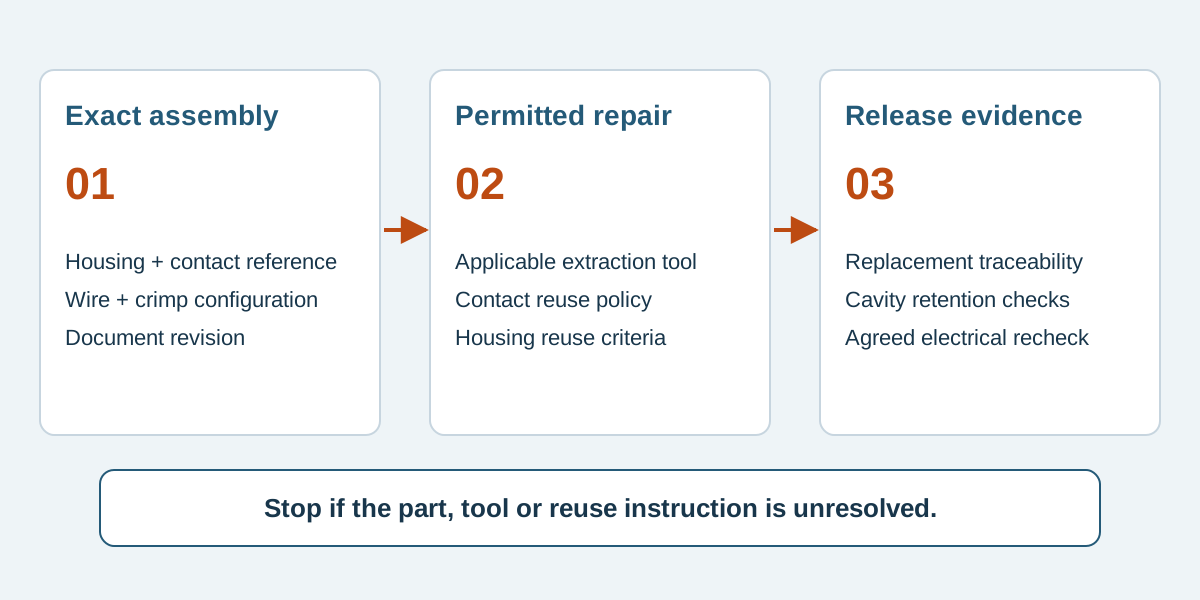
Conceptual illustration. Fictional examples are not approved product configurations, tooling instructions or inspection results.
Define why the contact needs to come out
Record whether the task is correcting a confirmed cavity assignment, investigating an intermittent circuit, replacing a damaged contact or examining a failed assembly. The purpose determines what evidence must be preserved and what the replacement must demonstrate.
If a terminal has backed out without intentional extraction, start with the terminal backout investigation guide. Removing it immediately can change the very retention features needed for investigation. If the whole connector is still mated, use its mating and unmating instructions; an extraction tool is not a latch-release tool for every interface.
Work only after the equipment has been isolated under its applicable procedure. Connector removal instructions do not replace equipment-specific electrical, stored-energy or service controls. Assign the work to personnel equipped for the identified assembly and authorized rework scope.
Match the tool to the complete combination
A family name or similar-looking contact is insufficient. Record the full contact reference, housing reference and applicable instruction revision. Check whether a secondary lock must be handled and whether the product is intended to permit contact extraction at all.
Scroll sideways to read all columns.
| Check before removal | Evidence to obtain | Decision if unresolved |
|---|---|---|
| Component identity | Exact contact and housing references | Hold the operation; improve identification |
| Tool applicability | Manufacturer's applicable combinations and tool reference | Do not substitute by tip appearance |
| Access and lock state | Instructions for this product and installed condition | Resolve access or lock requirements first |
| Reuse policy | Explicit instructions for extracted contact and housing | Keep reuse approval pending |
| Replacement route | New contact, suitable wire and applicable termination tooling | Determine whether a new lead or assembly is needed |
The connector documentation guide helps distinguish a tool specification from a general product catalog. Both may be required, but they answer different questions.
A specific Molex example and its limits
Molex ATS-011030044, revision N1, identifies extraction tool 11-03-0044, engineering number HT60630B. Its first-page applicability table includes contact 39-00-0038 in series 5556. Check the exact assembly against the complete applicable documentation before selecting a tool.
Page 2 includes an important exception: specified terminal-and-housing combinations involving 44478-*2 with 44157, and 44476 with 44156, require extraction tool 63813-1200. The same page states that removal by its described method damages the contact's locking tangs and the contact is not reusable. Page 3 has separate instructions for series 5378. Do not collapse those distinctions into one family-wide procedure.
This example explains why applicability and reuse must be checked together. It does not authorize tool 11-03-0044 for an unlisted part, a lookalike alternative or another connector series. Consult the actual document for its illustrated operation rather than generalizing an insertion direction from this article.
Make separate contact, housing and wire decisions
Contact: where the applicable instructions prohibit reuse, replace it. Bending a locking tang back into a convincing shape does not override that restriction. Contact replacement means a new termination, not transferring an old crimp barrel onto another wire.
Housing: assess it separately against the applicable criteria. An extracted contact's non-reuse rule does not automatically establish that the housing is either serviceable or scrap. Damage to a cavity, retention feature, key or lock may require housing replacement. If the relevant criteria or condition cannot be established, obtain a documented disposition rather than declaring it acceptable from a photograph.
Wire: determine whether a new termination can meet the approved construction after the old end is removed. Cutting back a lead changes the available length. Check the required length datum and tolerance, routing slack, conductor condition and insulation condition. If the lead cannot remain compliant, a new lead or assembly may be the appropriate scope.
New termination also requires the correct contact-wire-tool combination and its applicable instructions. A contact that fits the housing is not automatically suitable for every wire in the same nominal gauge.
A fictional cavity-correction decision
The following is a planning example, not an approved repair instruction. EX-R17, H-A and T-A are fictional identifiers.
EX-R17 revision A has a confirmed cavity error at end B. The approved connection list requires circuit C2 in cavity 2; sample R-03 was built with C2 in cavity 3. The team proposes extraction and correction before reevaluation.
Scroll sideways to read all columns.
| Question | Finding in the example | Required action |
|---|---|---|
| Is the circuit definition wrong? | Drawing A is correct; R-03 differs | Preserve the original finding and correct the build record |
| Is the contact reusable? | Applicable instructions prohibit it after removal | Plan a new T-A contact, not reinsertion of the old one |
| Can the wire be reterminated? | Cutting back would violate approved branch length | Replace the affected lead or assembly; customer approves scope |
| Can housing H-A remain? | Condition has not yet been assessed | Hold disposition pending applicable inspection |
| Is a new connection check enough? | Other affected characteristics remain unreviewed | Define checks for the replacement termination, retention and dimensions |
This record avoids a misleading outcome: a connector with the correct circuit order but a damaged contact or undersized branch. A repair should restore the specified construction, not only the symptom that first attracted attention.
Record the revised condition and approval
Trace the work to the assembly identifier and revision. Record the reason, affected cavities, removed parts, replacement references, relevant instructions, findings and any approved deviations. Identify the person or organization responsible for the disposition and verification.
Agree the necessary checks before work begins. These may include circuit assignment, affected dimensions and evidence for the new termination, as appropriate to the construction. A continuity result alone cannot establish every mechanical or material characteristic. The crimp inspection evidence guide explains why different checks answer different questions.
Do not quietly return an investigated or reworked sample to a pool of untouched samples. Label its history so subsequent evaluations can interpret its results. Where a customer approval was tied to the original build, assess whether the changed condition requires renewed review.
Frequently asked questions
Can I use a generic pin-removal kit?
Use a tool only when its applicability to the exact component combination is established through the relevant instructions. A tip fitting the opening does not demonstrate correct engagement with the retention feature.
Can I reuse a contact if it looks undamaged?
Follow the applicable reuse policy. The cited Molex example expressly prohibits reuse after the described removal method. Appearance does not cancel that rule, and the example should not be generalized into the policy for every other contact.
Does a TPA make depinning impossible?
It depends on the identified connector system and its instructions. Determine the actual secondary-lock arrangement and service provisions. The TPA and CPA guide explains the features without treating either as a universal add-on or a removal method.
Should I replace one lead or the whole assembly?
Compare the defined repair route, available length, condition of other parts and verification needed. If compliant rework cannot be demonstrated, obtain a replacement assembly proposal rather than repeatedly altering the same specimen.
Request a replacement scope with evidence
Send Zeakka the assembly identification, affected cavity views, exact known component references, applicable instructions and required finished dimensions. Zeakka is a sourcing and trading coordinator; any supplier rework or replacement route needs project-specific feasibility confirmation. Original JST and Molex components are considered only within finished assemblies, not supplied as loose original parts.
Share this article
Help others discover this content